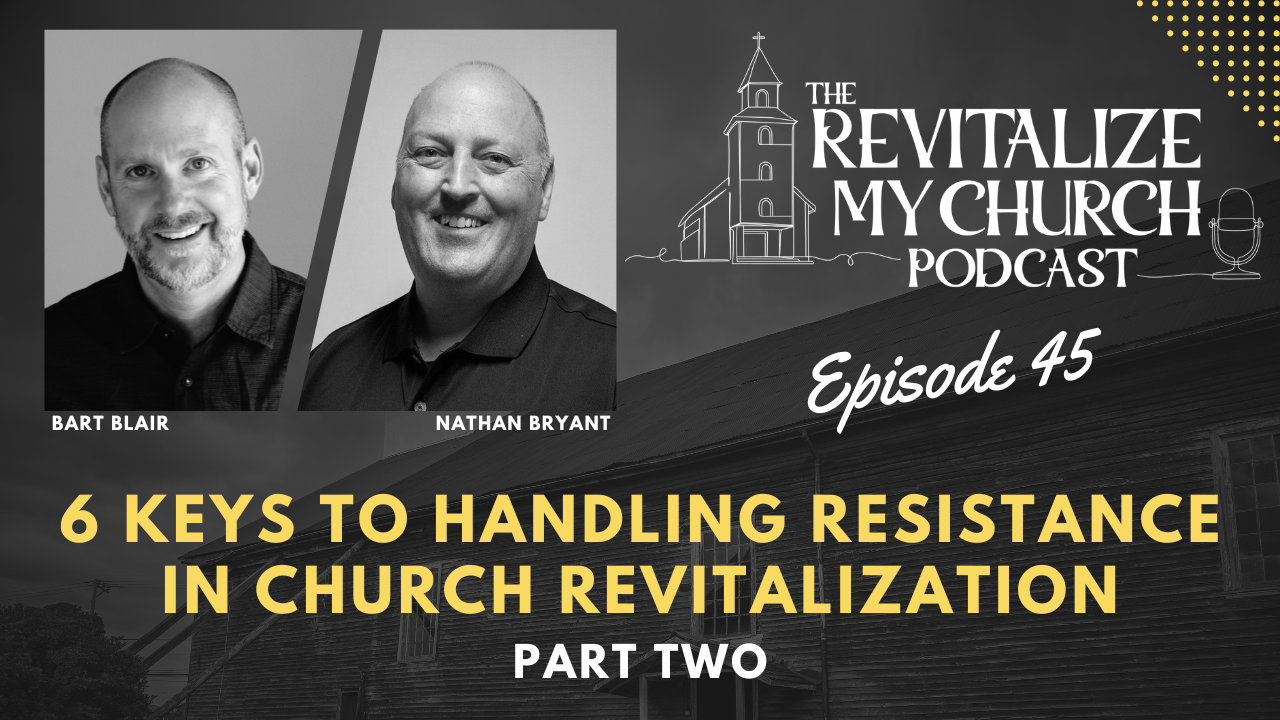
Ep. 045 | 6 Keys to Handling Resistance in a Church Revitalization - Part Two
Resistance is a Natural Part of Change Management in a Church
Listen on Spotify | Listen on Apple Podcasts
How to Handle Resistance in Church Revitalization: 6 Key Elements
June 1, 2026
Episode 45: Show Notes
Hosts: Bart Blair (Director of Church Revitalization, Assist Church Expansion) & Nathan Bryant (Executive Director, Assist)
4 Key Takeaways
Vision is your most powerful tool against resistance. Communicate the "why" behind every change early, often, and with genuine passion so your people understand where God is leading the church.
Honoring the past does not mean worshiping it. Acknowledge the church's history, celebrate its milestones, and allow people to grieve what is changing before asking them to embrace what is coming.
Pace and timing matter as much as direction. Knowing when to push forward and when to pause is a mark of mature leadership, not weakness or compromise.
Not all resistance is conflict. Learn to recognize when pushback has shifted into organized opposition, and be ready to respond differently when it does.
What Happened in the Previous Episode on Resistance in Church Revitalization
Episode 45 is the second half of a two-part mini series on handling resistance in church revitalization. In Episode 43, Bart and Nathan introduced the topic, established that resistance is common in nearly every revitalization context, and covered the first two keys: don't personalize it (contextualize it instead), and listen before you lead. If you missed that episode, go back and listen before diving into this one.
Why Communicating Vision Is the Best Response to Resistance (Key 3)
The third key is to communicate the vision often and clearly. Nathan makes the point that there is a fundamental difference between leading people and managing them. People do not want to be told what to do. They want to be inspired toward a compelling picture of the future.
Pastors coming into a revitalization situation have often been thinking about needed changes for months. To them, the path forward feels obvious. But the people in the pews may have been operating under the same assumptions about their church for 20, 30, or even 50 years. Moving them requires more than instruction. It requires inspiration.
A few principles for communicating vision effectively:
Vision is a leaky bucket. You have to keep filling it. Most leaders underestimate how many times people need to hear the why before they embrace the what.
Repeat it more than feels comfortable. Repetition is not redundancy. Repetition is leadership.
Own the vision so completely that when people push back, it flows naturally out of you.
Answer the four core questions your people are asking: Why are we doing this? Who are we? What are we going to do? Where are we going?
Anchor the vision in Scripture and missional purpose. It is much harder for people to argue against a biblically grounded why.
Let others carry the vision too. Personal testimonies and stories of life change are powerful vision reinforcers that go beyond anything the pastor alone can say.
How to Honor the Church's Past While Leading It Into a New Future (Key 4)
The fourth key is to honor the past while moving forward. Most resistance in a revitalization context is tied to something with historical significance. You are asking people to let go of something they have held onto for a long time.
Practical ways to honor the past without being held hostage by it:
Acknowledge it. New leaders who are entirely focused on the future and never acknowledge what came before create resentment among longtime members.
Celebrate historical markers. Whether it is a 25th or 50th anniversary, find ways to honor what God has done through the church's history. The congregation is able to receive new things partly because of the foundation that was laid.
Allow people to grieve. When you change a program, a style, a name, or a tradition, people are losing something real. Dismissing that grief is counterproductive. Acknowledge it. Tell people you know this is a sacrifice.
Become a historian. Bart advises pastors he coaches to find decades of board meeting minutes and read through them. Know the highs and the lows. Work stories from the church's history into your sermon illustrations. When your people see that you value their story, they will trust you to lead them toward a new one.
Get key older members to champion the new vision. When respected voices from the church's past embrace and articulate the direction you are leading toward, you multiply your influence significantly.
One clarifying point: you are changing form and format, not the core values. But you cannot honestly make that claim unless you have actually done the work to understand what the church has historically valued. Be married to the mission. Do not be married to the methodology.
Related episode: Bart also recently interviewed pastor and author Larry Davis on the topic of his book, "Grieving the Loss of the Church You Love." That episode covers the stages of grief as they apply to church loss and is worth listening to alongside this one. It will be linked in the show notes.
How to Know When to Push and When to Pause in a Church Revitalization (Key 5)
The fifth key is knowing when to push and when to pause. Pace and timing are just as important as direction.
Nathan used the illustration of a carousel horse: if it goes too fast, you fall off; if it goes too slow, it stops being worth the ride. There is a right pace for leading change, and finding it requires ongoing discernment.
A few things to keep in mind on pace and timing:
Start with low-hanging fruit. Early wins build leadership credibility and create the relational trust you will need when you go after bigger changes.
Build a team with people who know the church's history. What looks like a minor change to you may carry enormous emotional weight because of something that happened years ago. People with institutional knowledge can give you a reading on this before you push a button you did not know was loaded.
Pausing is not the same as stopping. A well-timed pause to address underlying concerns can grease the wheels for a much easier win later.
Do not squander momentum. If you have cast a compelling vision and your people are ready to move, do not keep talking without acting. Windows of opportunity close. People return to the familiar if you wait too long.
Choose your battles wisely. Some changes must happen. Some probably should happen. Some would be nice but would not move the needle much. Prioritize accordingly.
The goal is always to bring people with you, not to bulldoze through them. But bulldozing and stalling are both leadership failures. The goal is a discerning, paced advance.
How to Recognize When Resistance in Your Church Has Become Conflict (Key 6)
The sixth and final key in this series is knowing when resistance has crossed the line into conflict, because the two require very different responses.
A few red flags that suggest you have moved from resistance into conflict:
The shift from questioning the decision to questioning your right to make it. When someone moves from "why that change?" to "how dare you make that change," you are no longer dealing with resistance alone.
Organized opposition. When a person or group begins to recruit others around their concerns rather than bringing those concerns directly to leadership, you have likely crossed into conflict territory. In a small church, this can happen with just two or three phone calls.
Practical advice for staying ahead of this:
Have a person with a strong shepherding gift on your leadership team. If that is not your natural wiring, you need someone close to you who will notice the relational and emotional cues you might miss.
Keep someone in your inner circle who knows the church's history and its key players. They can give you a reading on how things are landing in ways you cannot always see from the front.
Engage conflict quickly. The longer it sits, the more entrenched it becomes.
When resistance becomes conflict, the principles shift. Bart and Nathan refer listeners back to Episodes 39 and 41, which cover the six keys to managing conflict in a church revitalization context.
One important closing thought from Nathan: do not let one or two resistant voices keep the church from becoming what Jesus wants it to be. Lead with kindness, grace, and vision. But do not confuse kindness with passivity.
And from Bart: if you are leading a church through revitalization and you are not experiencing any resistance, you may not be pulling the right levers. Some level of tension is a sign that real change is actually happening.
Resources and Episodes Mentioned
Episode 43: Keys 1 and 2 for Handling Resistance in Church Revitalization
Episode 44: Grieving the Loss of the Church You Love, featuring Larry Davis
Episodes 39 and 41: Six Keys to Managing Conflict in a Church Revitalization
About the Revitalize My Church Podcast
The Revitalize My Church Podcast is hosted by Bart Blair, Director of Church Revitalization for Assist Church Expansion, and Nathan Bryant, Executive Director of Assist Church Expansion. The show exists to help pastors of smaller, struggling churches navigate change and reorient to a new and healthy future. New episodes release regularly wherever you listen to podcasts.
If this content has been helpful, subscribe so you do not miss future episodes, leave a rating and review, and share the podcast with others in ministry who could benefit.
Connect With Us
Don't miss future episodes! Subscribe to the Revitalize My Church podcast wherever you listen (Apple Podcasts, Spotify, etc.) and leave a rating or review to help others discover the show.
About the Revitalize My Church Podcast: Since summer 2024, we've been helping church leaders navigate change and reorient to healthy futures. Our goal isn't to make small churches big—it's to help churches revision, revitalize, or restart find solid footing and healthy systems.