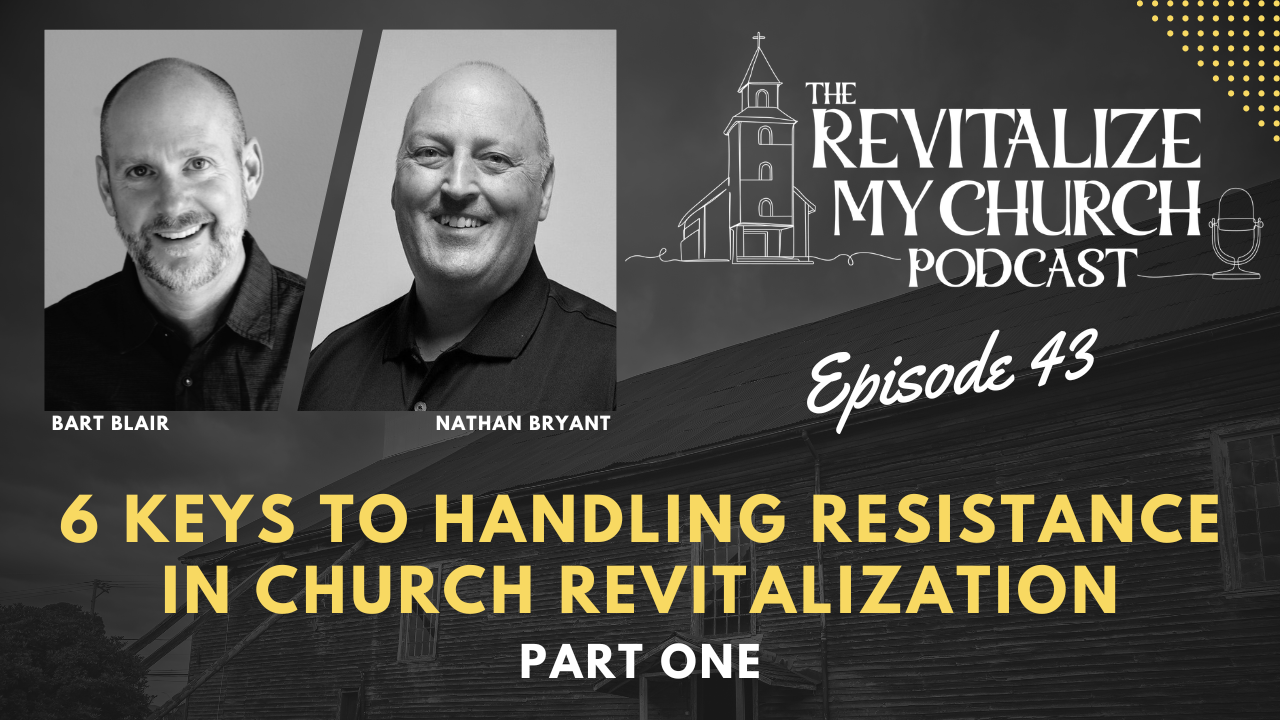
Ep. 043 | 6 Keys to Handling Resistance in a Church Revitalization - Part One
What to Do When You Get Pushback During Church Revitalization
Listen on Spotify | Listen on Apple Podcasts
Handling Resistance in Church Revitalization: 6 Key Elements
May 1, 2026
Episode 43: Show Notes
Hosts: Bart Blair (Director of Church Revitalization, Assist Church Expansion) & Nathan Bryant (Executive Director, Assist)
TL;DR: What You Will Learn in This Episode
• Resistance is a normal, inevitable part of leading a church through revitalization, not a sign that something is wrong.
• Resistance and conflict are not the same thing. Understanding the difference helps pastors respond with the right strategy.
• Key 1: Do not take resistance personally. Contextualize it instead. Your defensiveness will raise the temperature and make things harder.
• Key 2: Listen before you lead. Creating space for people to be heard, ask questions, and process change at their own pace dramatically reduces the heat around resistance.
What This Episode Is About
In this episode, Bart Blair and Nathan Bryant tackle one of the most common and frustrating challenges facing pastors in a church revitalization: resistance. Whether you are a new pastor trying to lead change in an established congregation or a longtime pastor who has finally decided to move your church in a new direction, resistance is part of the journey. This episode kicks off a two-part series with the first two of six practical keys for navigating that resistance well.
What Is the Difference Between Resistance and Conflict in a Church Revitalization?
Resistance and conflict are not the same thing, though one can lead to the other. Resistance is the natural pushback that comes when people are being asked to move from a familiar place to an unfamiliar one. It should be anticipated and planned for. Conflict, on the other hand, involves something more relational and potentially explosive. Something has been said or done, a misunderstanding has occurred, or an offense has been taken that now requires active resolution.
A helpful way to tell the difference: ask whether the person is questioning the decision being made or your right as a leader to make it. If they are questioning your authority to lead, you are likely moving into conflict territory. If they simply do not like the idea, that is resistance, and it can be managed with patience, communication, and trust.
Unmanaged resistance will almost always escalate into conflict. Think of it like stretching a rubber band. The further you pull, the more resistance you feel. Pull too hard, too fast, and it snaps.
Why Is Resistance Inevitable When a Pastor Leads a Church Through Change?
If you are leading your church through genuine change and not experiencing any resistance, you are probably not changing anything that truly matters. Resistance is the natural result of inertia. People who have worshiped, served, and sacrificed in a particular church for 20, 30, or 40 years have deep roots. Even when they intellectually want change, many do not fully realize what they are agreeing to until the change process is underway.
Several factors contribute to resistance in a revitalizing church:
• Fear of loss. People are not always resisting the change itself. They are often grieving what they will have to give up.
• Fear of another failure. Many congregations have tried to turn things around before. When those efforts did not pan out, it left wounds. Resistance is sometimes a protective response from people who do not want to be hurt or disappointed again.
• Lack of trust in the new leader. A congregation cannot follow a leader off the map until that leader has proven trustworthy on the map. Todd Bolsinger's book "Canoeing the Mountains" uses the story of Lewis and Clark to illustrate this point well. People trusted them in unfamiliar territory because of what they had already demonstrated in familiar territory.
• Feeling disrespected or dismissed. When change is communicated poorly, it can feel to longtime members like the pastor is calling everything they built, sacrificed for, and loved worthless. Even when that is not the intent, the perception can fuel significant resistance.
What Can Pastors Learn from Moses About Leading a Congregation Through Resistance?
Moses is one of the most instructive figures in Scripture for any pastor navigating change. He led a people who had cried out to God for deliverance, received it, and then spent most of the journey complaining about the process. A few things stand out from his example:
• The people who say yes to the journey do not always fully understand what they are agreeing to. That is true of congregations today.
• Moses did not always keep his cool. He was described as the meekest man who ever lived, but he still lost his temper. Pastors are not required to be perfect, only persistent and humble.
• Moses interceded for the people even when they deserved judgment. As a pastor, your congregation is not your adversary. They are the people God has given you to love and lead.
• Moses did not have the full plan from day one. God revealed it over time. Revitalization leaders rarely have a complete roadmap either. Flexibility and faith are both required.
Key 1: How to Stop Taking Resistance Personally as a Church Revitalization Leader
The first key to handling resistance is to contextualize it rather than personalize it. When a pastor becomes anxious or defensive in response to resistance, that anxiety spreads. It raises the temperature in the room and makes the situation harder to manage.
Proverbs 19:11 says that wisdom yields patience and that it is to one's glory to overlook an offense. That is not passivity. It is strategic leadership. Most resistance is not really about you. It is about the concept of change, the fear of loss, or the memories tied to something you are asking people to let go of.
That said, pastors also need to guard against unintentionally making it personal for the people resisting. When change is communicated without empathy, without honoring what came before, and without acknowledging the sacrifice people have made over the years, it can feel deeply personal to them. Effective revitalization leaders hold both of these things at once: they do not take resistance personally, and they take care not to make others feel personally attacked by the changes being proposed.
Key 2: Why Listening Before Leading Is Critical in a Church Revitalization
James 1 instructs believers to be quick to hear, slow to speak, and slow to anger. That is not just pastoral counsel for conflict. It is a practical strategy for managing resistance in a change process.
Listening to someone is not the same as agreeing with them. But creating space for people to voice concerns, ask questions, and process what is being proposed will dramatically reduce the temperature around resistance. Bart and Nathan discuss the importance of a concentric, layered communication strategy:
• Bring change concepts first to top-level leaders, not as finalized decisions but as ideas to interact with and respond to.
• Give leaders time to process, react, and come back to the table. Some people will be immediately on board. Others need time. Others will push back. All of that is normal.
• Offer one-on-one opportunities for people to talk with you directly. Springing a major change on a full congregation before key voices have had a chance to process it privately is a recipe for public conflict.
• Ask better questions. One book worth exploring on this topic is "The Art of Asking Better Questions." Getting skilled at asking the right questions in the right order can help a pastor peel back the layers and find the actual root of someone's resistance, which is often something very different from the surface issue.
A practical example from the podcast: a pastor was facing resistance from a longtime member over removing the church's pews. When the pastor took the time to listen and dig deeper, he discovered the real concern had nothing to do with pews versus chairs. The member was afraid the dedicated memorial pews would be thrown away. The pastor found a church willing to purchase them, and everyone walked away honored and cared for. That kind of outcome is only possible when a leader chooses to listen before leading.
What's Coming in Episode 45: Four More Keys to Handling Resistance in Church Revitalization
This episode covers the first two of six practical keys for handling resistance in a church revitalization. Bart and Nathan will continue the conversation in Episode 45 with four more keys. Make sure you are subscribed wherever you listen so you do not miss the conclusion of this series.
New episodes release on the 1st and 15th of every month.
Resources Mentioned in This Episode
• "Canoeing the Mountains" by Todd Bolsinger
• "The Art of Asking Better Questions" (J.R. Briggs)
• Episodes 39 and 41: Six Keys to Managing Conflict in a Church Revitalization (Parts 1 and 2)
Connect With Us
Don't miss future episodes! Subscribe to the Revitalize My Church podcast wherever you listen (Apple Podcasts, Spotify, etc.) and leave a rating or review to help others discover the show.
About the Revitalize My Church Podcast: Since summer 2024, we've been helping church leaders navigate change and reorient to healthy futures. Our goal isn't to make small churches big—it's to help churches revision, revitalize, or restart find solid footing and healthy systems.