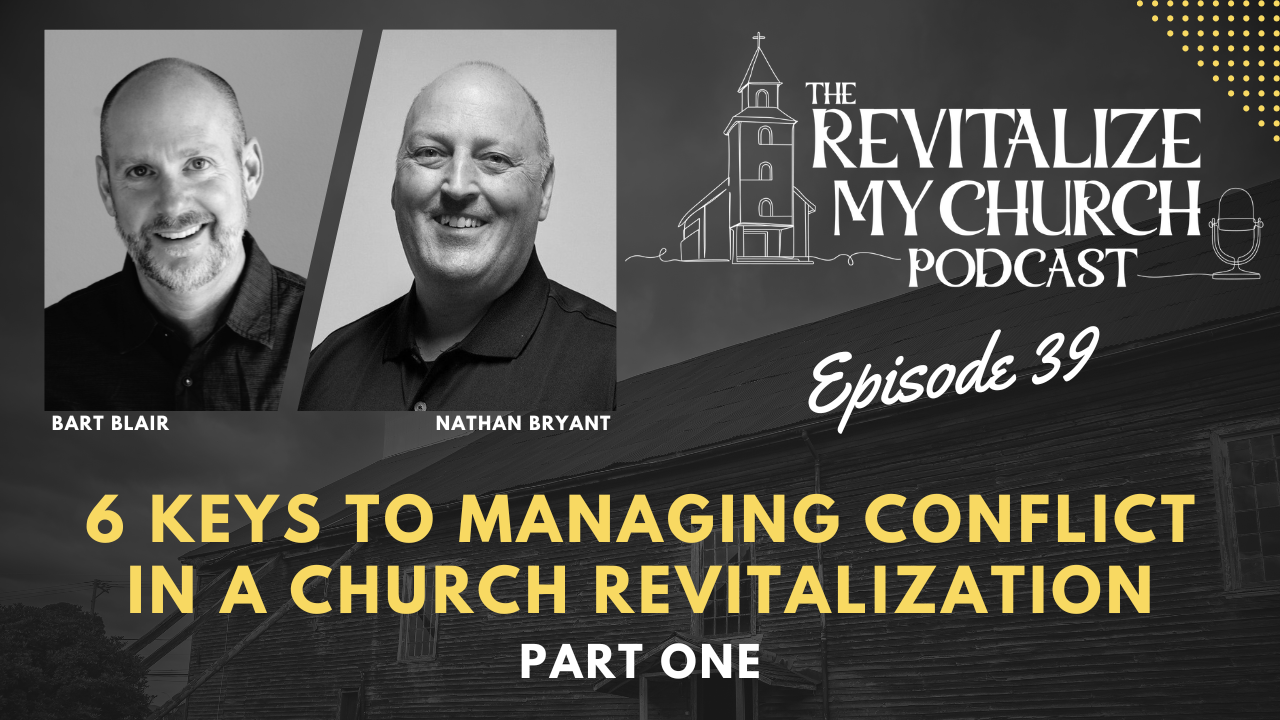
Ep. 039 | 6 Keys to Managing Conflict in a Church Revitalization - Part One
How To Handle Conflict During Church Revitalization
Listen on Spotify | Listen on Apple Podcasts
Managing Conflict in Church Revitalization: 6 Essential Keys
March 1, 2026
Episode 39: Show Notes
Hosts: Bart Blair (Director of Church Revitalization, Assist Church Expansion) & Nathan Bryant (Executive Director, Assist)
TLDR: Key Takeaways
Conflict is normal in churches - 75% of 14,000+ surveyed churches experienced conflict; it's not an exception, especially during revitalization
Conflict differs from resistance - Resistance to change requires different handling than general congregational conflict between members
Face reality: conflict will come - Change creates conflict; prepare your leadership team to expect and plan for it rather than being blindsided
Move toward conflict quickly but wisely - Address issues within 48-72 hours to prevent escalation, but take time to pray and process first
Always go face-to-face - Never resolve conflict through text or email; digital communication strips away tone and escalates tension
Bring a witness - Leaders should include an elder or team member when mediating conflict to ensure accountability and accurate reporting
How Do You Handle Conflict During Church Revitalization?
Conflict is one of the most challenging aspects of leading a church through revitalization. In this episode, Bart Blair and Nathan Bryant tackle the reality that 75% of churches experience some level of conflict - and provide practical keys for navigating it successfully.
Why Is Conflict So Common in Churches Going Through Revitalization?
Church revitalization creates a perfect storm for conflict:
Change itself generates tension between longtime members and new vision
Power dynamics shift as leadership structures evolve
Resource scarcity creates disagreements about priorities
Unspoken expectations lead to assumptions and misunderstandings
Communication gaps allow gossip to fill the vacuum
According to the Faith Communities Today (FACT) study of over 14,000 congregations, the top sources of church conflict are:
Member behavior (44%)
Money and finances (42%)
Worship style (41%)
Leadership style (40%)
Decision-making processes (39%)
Program priorities (30%)
Theology and doctrine (26%)
What's the Difference Between Conflict and Resistance in Church Revitalization?
Before diving into conflict management strategies, it's important to understand that resistance to change is different from general congregational conflict. Resistance specifically relates to pushback against new initiatives, while conflict can arise from interpersonal issues, behavior problems, or disagreements unrelated to revitalization efforts.
This episode focuses on managing conflict that occurs between members and maintaining unity - a primary responsibility of church leadership.
Key #1: Face Reality - Conflict Will Come
Scripture Foundation: "Count it all joy, my brothers, when you meet trials of various kinds, because you know that the testing of your faith produces perseverance." - James 1:2-4
How Should Pastors Prepare for Inevitable Church Conflict?
Rather than being surprised or defensive when conflict emerges, church leaders must:
Normalize conflict without treating it as catastrophic
View it as an opportunity to bring unity and address underlying issues
Prepare your leadership team to expect and plan for conflict
Recognize common triggers like worship changes, leadership transitions, budget discussions, and demographic shifts
The key mindset shift: Conflict isn't necessarily bad - it's an opportunity to discover what people care about, clarify misunderstandings, and ultimately strengthen unity when handled well.
Why Do Even Experienced Pastors Get Blindsided by Church Conflict?
Many pastors with decades of experience still feel caught off guard by conflict because:
Most leaders are idealistic and expect the best from people
Conflict often comes from unexpected sources - the people you'd least expect
Pastors are typically well-trained to handle theological disputes but poorly prepared for interpersonal and behavioral conflicts
Key #2: Move Toward Conflict Quickly (But Wisely)
Scripture Foundation: "In your anger do not sin: Do not let the sun go down while you are still angry, and do not give the devil a foothold." - Ephesians 4:26-27
What Is the Right Timing for Addressing Church Conflict?
The 48-72 hour rule provides a balanced approach:
Don't let conflict fester - wounds become infected, gossip fills the vacuum, and small issues escalate
Don't react impulsively - you need time to pray, process, and plan your approach
Act within 48-72 hours of discovering the conflict
What Three Things Happen When Church Leaders Delay Addressing Conflict?
Small conflicts escalate quickly in anxious church systems, especially in smaller congregations
Gossip fills the vacuum of leadership silence - when people lack facts, they make assumptions (usually negative)
People evaluate your leadership based on how you handle (or fail to handle) tension - your authority, competence, and character are all on display
How Should Church Leaders Prepare to Address Conflict?
Follow this three-phase approach:
PRAY - Stop and pray individually or as a leadership team before taking action
PROCESS - Write down exactly how you'll handle the conflict:
What you'll say and how you'll say it
How you might respond to different reactions
Who needs to be involved in the conversation
Map out the approach (even if it doesn't go according to plan)
ACT - Schedule the meeting promptly within that 48-72 hour window
Should You Expect Reconciliation in the First Meeting?
No. The first meeting should focus on fact-finding:
Enter with a listening posture
Ask excellent questions
Gather what all parties perceive as the facts
Remember: both parties believe their version of the story
Only after this initial investigation can you formulate a plan for reconciliation and restoration. Rushing to resolution without understanding all perspectives usually backfires.
Key #3: Go Face-to-Face
Scripture Foundation: "If your brother or sister sins, go and point out their fault, just between the two of you." - Matthew 18:15-16
Why Is Face-to-Face Communication Essential for Resolving Church Conflict?
Digital communication - especially text and email - is disastrous for conflict resolution because:
Tone is stripped away - messages are easily misinterpreted
Body language is absent - you can't read emotional state or intent
Words become weapons - texts and emails can be screenshot, forwarded, and used against you
Escalation happens 10x faster - misunderstandings multiply through digital channels
What Does the Research Say About Text Message Conflicts?
In real conflict situations, the same text message read by the sender sounds completely different than when read by the receiver. The sender's intended tone and meaning gets lost, replaced by the receiver's interpretation - often negative.
What Is the Hierarchy of Communication for Church Conflict Resolution?
In-person meeting (best option - always pursue this first)
Video call (if necessary due to distance)
Phone call (bare minimum acceptable)
NEVER text or email for conflict resolution (use only to schedule face-to-face meetings)
Should Church Leaders Meet Alone When Addressing Conflict?
No. Leaders should bring an elder or team member as a witness because:
Accountability - keeps everyone's behavior in check during difficult conversations
Accuracy - provides objective verification of what was actually said
Protection - prevents "he said, she said" situations later
Wisdom - multiple perspectives help navigate complex situations
Light - ensures conversations happen with appropriate oversight, not in secret
This is especially important when mediating between two conflicting parties or when the conflict involves the pastor directly.
What Covenant Should Church Leadership Teams Make About Conflict?
Establish these three commitments:
We will meet with persons involved in conflict within 72 hours of discovering it
We will NOT resolve conflict through digital communication - always face-to-face
We will include another elder/leader when mediating conflict to ensure accountability
What Does "Go Up, Not Out" Mean in Church Conflict?
This simple phrase (taught by Pastor Thornley) helps congregation members understand Matthew 18:
"Go UP" = Take your concern directly to the person involved or to leadership
"Go OUT" = Spreading the issue to friends, gossip networks, and uninvolved parties
Teaching this principle helps prevent conflict from spreading throughout the congregation like wildfire.
What Are the Costs When Church Conflict Is Handled Poorly?
According to the FACT study, when conflict isn't managed well:
69% of churches lost members
39% experienced financial loss (people vote with their pocketbooks)
25% lost their leader (pastor resigned, was fired, or left)
Damaged relationships, broken trust, bitterness, and sadness prevail
What Are the Benefits When Church Conflict Is Handled Well?
The same research shows powerful positive outcomes:
80% of vital, spiritually alive congregations deal openly with conflict
94% of pastors report positive outcomes when conflict is properly addressed
Results include: greater wisdom, better vision clarity, stronger relationships, church purification, and increased unity
Jesus even prioritizes conflict resolution over worship: "Leave your gift at the altar and go make it right with your brother" (Matthew 5:23-24). Unity in the body is that important to God.
Coming in Part 2: Three More Keys to Managing Church Conflict
In the next episode, we'll cover:
Key #4: Check Your Own Heart First
Key #5: Deal Openly (Not Publicly)
Key #6: Seek Win-Win Solutions
Don't miss these critical remaining keys for successfully navigating conflict during church revitalization.
Resources for Managing Church Conflict
Download the Faith Communities Today (FACT) Congregational Conflict Study - insights from 14,000+ churches on conflict sources, costs, and outcomes.
About Revitalize My Church Podcast
Hosted by Bart Blair (Director of Church Revitalization at Assist Church Expansion) and Nathan Bryant (Executive Director), this podcast helps pastors and leaders of smaller, struggling churches navigate change and build healthy futures. New episodes release on the 1st and 15th of each month.
Subscribe so you don't miss Part 2 of this essential series on conflict management in church revitalization.
Is your church experiencing conflict right now? What questions do you have about implementing these principles? Share your thoughts in the comments below.
Connect With Us
Don't miss future episodes! Subscribe to the Revitalize My Church podcast wherever you listen (Apple Podcasts, Spotify, etc.) and leave a rating or review to help others discover the show.
About the Revitalize My Church Podcast: Since summer 2024, we've been helping church leaders navigate change and reorient to healthy futures. Our goal isn't to make small churches big—it's to help churches revision, revitalize, or restart find solid footing and healthy systems.