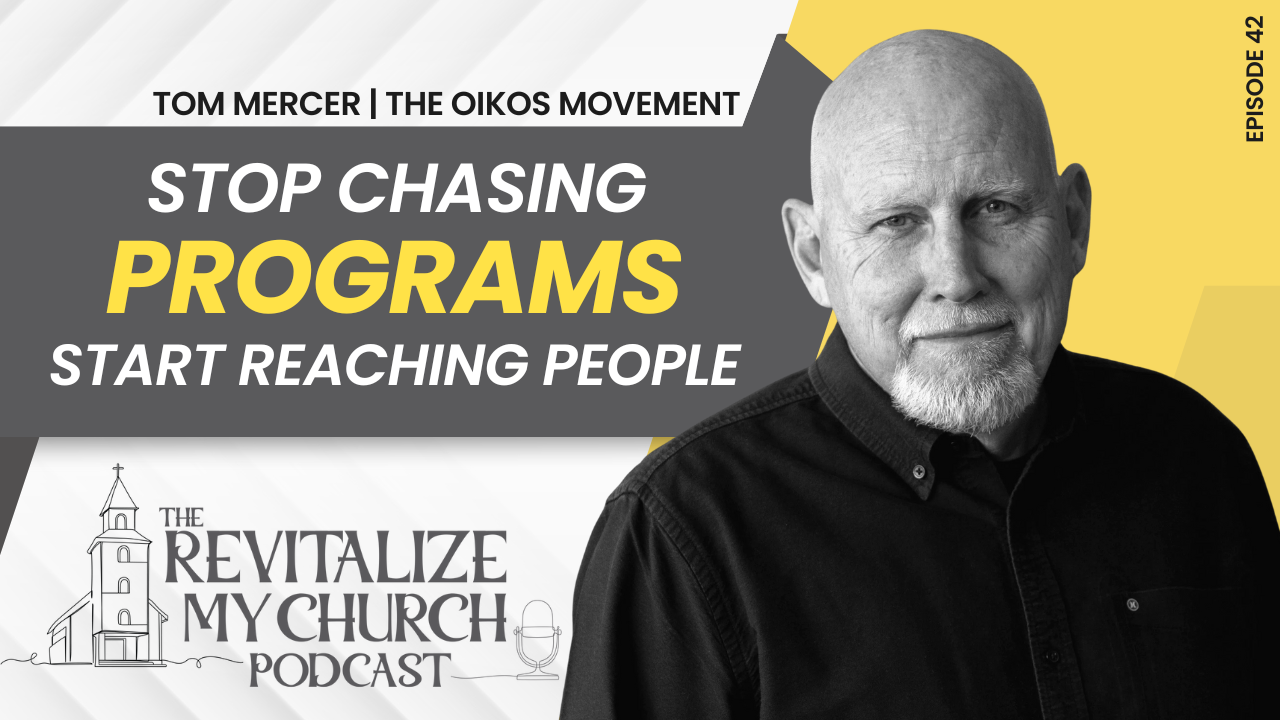
Ep. 042 | Stop Chasing Programs. Start Reaching People
Why Most Churches Are Distracted from the One Thing Jesus Asked Us to Do
Listen on Spotify | Listen on Apple Podcasts
How to Refocus Your Small Church on Evangelism Instead of Programs
April 15, 2026
Episode 42: Show Notes
TLDR: Key Takeaways
The Oikos Principle works everywhere: 95% of people come to faith through relationships with the 8-15 people in their "front row" - their coworkers, neighbors, close friends, and family members who watch how they live.
Church obesity kills mission focus: Most churches are programmatically obese, offering so many "good things" that the Great Commission gets crowded out. The average church attender has only 5 hours per week to give.
Outreach never happens naturally: Without intentionality, nurture always wins over evangelism. Churches must deliberately elevate the Great Commission first and often, or it will never take root.
Start with a simple strategy: Make a list of your 8-15 people, pray daily, invest in relationships intentionally, then invite them into environments where faith conversations happen naturally.
Episode Summary
Are you struggling to keep your church focused on reaching lost people? Do you feel like your congregation is more interested in adding new ministries than making new disciples? You're not alone.
In this episode of Revitalize My Church, Bart sits down with Tom Mercer, author of 8 to 15: The World Is Smaller Than You Think and pastor of High Desert Church for 38 years, to discuss why most churches have lost focus on the only thing Jesus commanded us to do between His advents - make disciples.
Why Small Churches Struggle with Mission Focus
Tom shares candidly about the challenge every pastor faces: "It's not that local churches don't do good things, but we do so many good things that the only great thing Jesus asked of us doesn't have any room to flourish."
This insight is particularly crucial for small church pastors who are constantly pressured to add more programs, more ministries, and more activities to compete with larger churches in their community.
What Is the Oikos Principle and How Does It Work in Church Revitalization?
The word "oikos" is a Greek term meaning "house" or "household" that appears throughout the New Testament. But Tom explains it means more than just a physical dwelling - it describes your relational world.
The Oikos principle teaches that every person has 8-15 people in the "front row seats" of their life - people who:
Watch how you live
Listen to what you say
Include coworkers, neighbors, close friends, classmates, and family members
Are supernaturally and strategically placed in your life by God
The data is undeniable: Tom has asked hundreds of thousands of Christians across five continents, multiple denominations, and diverse cultures one question: "Was the primary reason you gave your heart to Christ because of someone in your oikos?"
The answer? Virtually every hand in the room goes up, every time.
How to Implement the 8 to 15 Strategy in Your Church
Tom shares the practical five-step strategy High Desert Church used to keep thousands of people focused on the Great Commission:
Step 1: Make a List
Help your congregation identify by name the 8-15 people in their front row. "It's only a dream until you write it down, then it becomes a goal," Tom explains, quoting NFL Hall of Famer Emmett Smith.
Step 2: Pray Daily
Encourage consistent prayer for these specific people by name. Most believers never take this step.
Step 3: Invest in Relationships
Be intentional about spending time with and serving these people. This is where most invitation strategies fail - people won't invite those they haven't invested in.
Step 4: Extend Invitations
Create environments where faith conversations can happen naturally - church services, dinner at home, coffee shops, or small group gatherings.
Step 5: Minimize Distractions
This is the controversial part: remove programs and activities that don't directly support your congregation's mission to their 8-15.
Why Church Programs Are Killing Your Evangelism Efforts
One of the most convicting moments in this conversation comes when Tom shares High Desert Church's "five-hour strategy."
After surveying their congregation, they discovered people could only give five hours per week to church activities. So they asked: "What do we do with only five hours?"
Their answer:
90 minutes: A meaningful weekend worship service
2 hours: Small groups for conversation and community
90 minutes: Opportunities to express spiritual gifts at church or in the community
That's it. Everything else was eliminated or offered only as short-term seminars.
The result? A church of 120 grew to thousands across four campuses over 38 years, with a laser focus on equipping every member to reach their oikos.
How to Stop Nurture from Winning Over Outreach in Your Church
Tom references his friend Dave Browning's insight: "Without intentionality, nurture always wins."
This explains why 76% of evangelical church-attending Christians can't even articulate what the Great Commission is (according to 2024 Barna research). Churches teach programs, not mission.
The solution? Elevate outreach first and foremost without compromising discipleship.
Tom shares a controversial practice: "When someone comes to faith, most pastors say, 'You need to get in a Bible study.' My advice would be to never, ever, ever do that."
Instead, paint the target first - help new believers understand their mission is to reach their 8-15 people. Then discipleship has context and purpose.
Why the Great Commission Should Be Called the Great Commandment
Bart makes a crucial point in this conversation: "We've labeled it the Great Commission, and commission sounds too much like suggestion. It should be another Great Commandment."
Jesus didn't say, "Here's a great idea if you have time." He said, "All authority in heaven and on earth has been given to me. Therefore GO" (Matthew 28:18-19).
This is a directive from the Commander-in-Chief, not a suggestion from a consultant.
Practical First Steps for Pastors Who Want to Implement Oikos Principles
If you're ready to refocus your church on the Great Commission using the oikos principle, Tom recommends:
Gather your decision-makers - staff team and key volunteers
Read together - Either 8 to 15 or Tom's follow-up book Not My Church (written specifically for pastors)
Have honest conversations - People in ministry are smarter than they think; let them wrestle with how to apply this in your specific context
Reach out for help - Tom offers free Zoom consultations with pastors at OikosMovement.com
Why This Strategy Works for Small Churches with Limited Resources
This approach is perfect for small church revitalization because:
It doesn't require a big budget - You're empowering relationships, not funding programs
It doesn't require more staff - Every member becomes a missionary to their oikos
It actually simplifies ministry - You can cut programs that distract from the mission
It's scalable - Whether you have 20 people or 2,000, everyone has 8-15 people in their front row
As Tom reminds us: "The average church is led by averagely gifted leaders." But the oikos principle doesn't require exceptional gifts - just faithfulness to focus on what Jesus actually asked us to do.
How to Measure Kingdom Growth vs. Transfer Growth
One of the most refreshing aspects of Tom's perspective is his view on measuring growth: "It's above my pay grade to cause growth, so it's kind of silly for me to take credit for it by measuring it."
Instead, Tom focuses on faithfulness to the mission, not numerical outcomes.
Bart reinforces this with the concept of lead measures vs. lag measures:
Lead measures - Things you can control (teaching the oikos principle, equipping people for relationships, removing program distractions)
Lag measures - Things you can't control (attendance numbers, baptisms, conversions)
Focus on leading your people to engage their oikos faithfully. Let God handle the growth.
What to Do When People Ask for More Programs and Ministries
Every small church pastor faces this pressure: "We need a women's ministry. We need more youth programs. We need this and that ministry."
Tom's response? Ask "Why?"
"If this is something Jesus asked of us, then of course we're obligated to pursue it. But there are so many things that are so distracting."
Before adding any program, ask: Does this help our people reach their 8-15, or does it distract from that mission?
The Sociological Problem, Not Just Theological
Bart shares a crucial insight: Most Americans believe people who resist the gospel have theological problems. In reality, their resistance is mostly sociological.
People resist God, scripture, and the gospel primarily because their entire oikos - the 8-15 people in their front row - also resist these things.
The solution? Change their sociological circle. Surround them with people who love Jesus, follow scripture, and live out the gospel. Their eyes open to new possibilities when their community changes.
This is why the oikos principle is so powerful - you're not just sharing information, you're inviting people into a new community.
Resources Mentioned in This Episode
Book: 8 to 15: The World Is Smaller Than You Think by Tom Mercer
Book: Not My Church by Tom Mercer (specifically for pastors)
Website: OikosMovement.com - Free resources and consultation opportunities
Contact: Tom@OikosMovement.com
Connect with Tom Mercer
Tom Mercer served as lead pastor of High Desert Church in Southern California for 38 years, growing the church from 120 attenders to thousands across four campuses. He now leads The Oikos Movement, a nonprofit dedicated to equipping every believer in every nation to reach their oikos with the gospel. Tom regularly consults with pastors worldwide via Zoom and speaks at churches and conferences about the oikos principle.
Questions for Reflection and Discussion
Can you name the 8-15 people in your oikos right now? Have you written their names down?
What programs or activities in your church might be "good things" that are crowding out the "great thing" Jesus commanded?
If your congregation only has five hours per week to give, what would you prioritize?
What percentage of your church members could accurately explain the Great Commission?
Does your church naturally gravitate toward nurture or outreach? What would it take to be more intentional about evangelism?
Share This Episode
If this conversation encouraged you or challenged your thinking about your church's future, share it with:
Your church leadership team or board
Your pastor or denomination leader
Church planter networks in your area
Other pastors navigating similar challenges
Subscribe & Stay Updated
New episodes release on the 1st and 15th of every month. Subscribe wherever you listen to podcasts or on YouTube to get notified when new conversations about church leadership, revitalization, and growth drop in your feed.