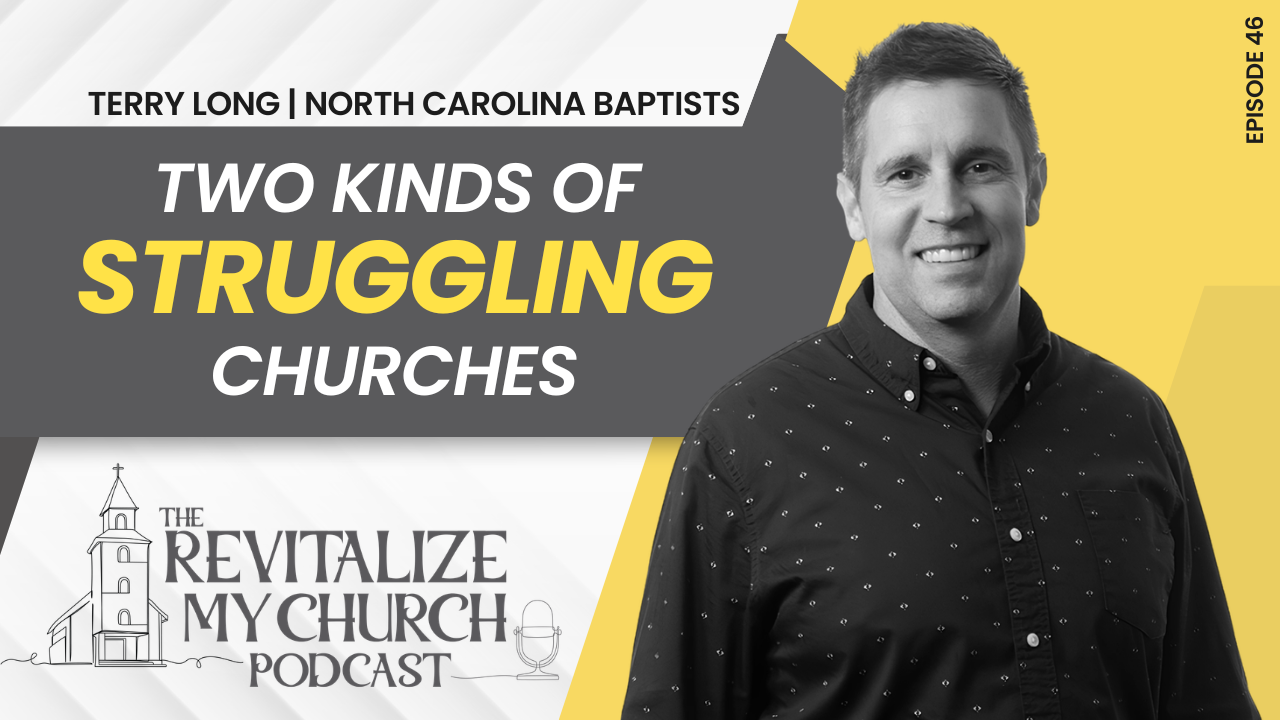
Ep. 046 | Two Kinds of Struggling Churches
How NC Baptists Assess and Respond to Churches in Decline
Listen on Spotify | Listen on Apple Podcasts
Terry Long on How NC Baptists Assess and Respond to Churches in Decline
June 15, 2026
Episode 46: Show Notes
TL;DR - Key Takeaways
1. Not all struggling churches need the same kind of help. NC Baptists divides churches into two groups: those with enough resources for internal revitalization, and those that are far enough down the life cycle that they need reconstruction with the help of a healthier church.
2. Revitalization has to start with the pastor. The most common mistake churches make is thinking the church needs to be revitalized when the pastor needs to go first.
3. A healthy church is not defined by attendance numbers. It is defined by whether the church is making and multiplying disciples, engaging its community, and equipping people of all ages for mission.
4. The cultural shift away from 'church is what you do on Sunday' is not a threat to the church. It is the Lord refining his church back to what it was always supposed to be: a people who go and make disciples rather than waiting for people to come.
About This Episode of the Revitalize My Church Podcast
In this episode, Bart sits down with Terry Long, Church Health and Revitalization Strategist for the Baptist State Convention of North Carolina. Terry joined the state convention in April 2020, holds a doctorate of ministry in church revitalization from Southeastern Baptist Theological Seminary, and brings two decades of vocational ministry experience to the work of helping churches turn around.
The conversation covers how NC Baptists approaches church assessment, why struggling churches fall into two distinct categories, what pastors get wrong when they ask for help, and why Terry believes the current cultural moment is actually good news for churches willing to engage it.
How does a state convention decide what kind of help a struggling church actually needs?
When Terry came into his role, call volume exploded and his team quickly realized they needed a consistent way to assess each church before diving into a solution. They developed a ten-question assessment designed not to give the church an answer but to help the church see its own reality clearly.
That assessment divides churches into two groups:
• Revitalization candidates: Churches that are plateaued or in slow decline but still have the people, money, and organizational health to do internal revitalization work with outside coaching.
• Reconstruction candidates: Churches that are further down the life cycle, typically thirty or fewer people, heavily aged up, with no pastor and limited resources. These churches need a healthier church to get involved through fostering, replanting, adoption, or a merger.
The assessment focuses on two primary areas: missional engagement (Is the church reaching people? Are they seeing baptisms? How is the community responding to them?) and discipleship health (Are they equipping and empowering younger leadership, or are they holding positions until someone passes away?).
"We don't want to answer the question for a church of what level of health it has. We want you to answer that for yourselves. Once you're able to see it, you should be able to recognize it."
What does a healthy revitalization actually look like on the ground?
Terry shared two stories from NC Baptist churches, both without naming the churches to protect their privacy.
The first was a church in the Rocky Mount area, still running around 100 to 200 people, that put everything on the table. They committed to focus on discipleship and missional engagement regardless of how long they had been doing things a certain way. Since then, they have doubled in size and hit Easter attendance of 400 people.
The second was a church of about thirty people, all senior adults, with no pastor and no clear direction. NC Baptists engaged them in a fostering-to-replant process, bringing three healthy churches together to rotate pastors, preach through the same book of the Bible, help launch a children's ministry, and support outreach. Six months in, the church had grown from thirty to 55 or 60 people and baptized ten people on Baptism Sunday.
Terry pointed to one shared factor in both stories: the churches stopped focusing on what they were losing and started focusing on what they could gain.
"We've got to stop focusing on what we're losing and really hone in on what we're gaining."
Why do most pastors misunderstand what revitalization is going to require?
The most common misconception Terry hears is a pastor calling to say his church needs to be revitalized, when the real issue is that the pastor needs to be revitalized first.
"You can't lead a church where you're not going yourself."
Terry also cited a statistic that 92 percent of pastors have never been personally discipled. If a pastor has never experienced one-on-one discipleship, he will not know how to build a discipleship culture in his church, and that is foundational to any revitalization effort.
Bart echoed this point from a different angle: most pastors are trained to be Bible teachers, not missionaries. The result is a ministry identity built around disseminating the Word from the front of a room rather than modeling what it looks like to be a disciple in the community. Terry and Bart both landed on the same practical challenge: if you are going to lead your church toward mission, start by knowing your neighbors' names.
Why are so many churches still stuck in a come-and-see model that no longer works?
Terry observed that nine out of ten churches he works with are still operating on the assumption that if they can improve their preaching, music, children's ministry, or hire a youth pastor, people will come. That model worked in the 1980s and 1990s when church attendance was a default cultural behavior. It does not work now.
Today, a person outside the church is choosing between church and nine other things on a Sunday morning. The only reliable bridge into that person's life is a relationship. Studies are showing that the majority of unchurched people would come to church if someone they had a real relationship with invited them. The implication is simple: churches have to go build those relationships before they can issue meaningful invitations.
"We've got to go to what a healthy church is and what we're to be. Because most of the people we talk to, they're trying to get back to a model of church in the eighties and nineties where church is still what you did."
Terry closed with a perspective that reframes the challenge entirely. The decline of cultural Christianity is not the enemy of the church. It is the Lord refining his church back to its original calling: go and make disciples, rather than sit and attract them.
"I actually think this is a great thing. I know a Lord that said we're supposed to go and make disciples of all nations. I actually think this is the Lord refining his church to get back to do what we were supposed to do in the first place."
Resources Mentioned
• NC Baptists Church Revitalization: ncbaptist.org/ministries/church-revitalization
• North American Mission Board Replant: https://www.namb.net/church-replanting/
• Reclaiming Glory by Mark Clifton
• Embers to a Flame by Harry Reeder
• Church revitalization resources by Tom Chaney (Orlando Baptists)
Reflection Questions for Pastors and Church Leaders
1. Has your church been assessed recently? Do you have a clear, honest picture of where you actually are -- not where you were ten years ago?
2. Which camp does your church fall into: a revitalization candidate with resources to do the work internally, or a reconstruction candidate that may need outside help from a healthier church?
3. When did you last invest in your own discipleship? Who is helping you grow, and who are you helping take their next step?
4. How many people in your surrounding community know you personally -- not as a pastor, but as a neighbor?
5. If your church committed to defining what a healthy New Testament church looks like and took one step toward that this year, what would that step be?
Share This Episode
Do you know a pastor who is carrying the weight of a struggling church and wondering if there is any real hope? This conversation was built for them. Share this episode and let them know they are not alone in what they are facing.
Subscribe and Leave a Review
If this episode was helpful, the best thing you can do is subscribe to Revitalize My Church wherever you listen to podcasts. New episodes drop on the first and fifteenth of each month. And if you have a moment, leave a review. It helps more pastors and church leaders find this content.