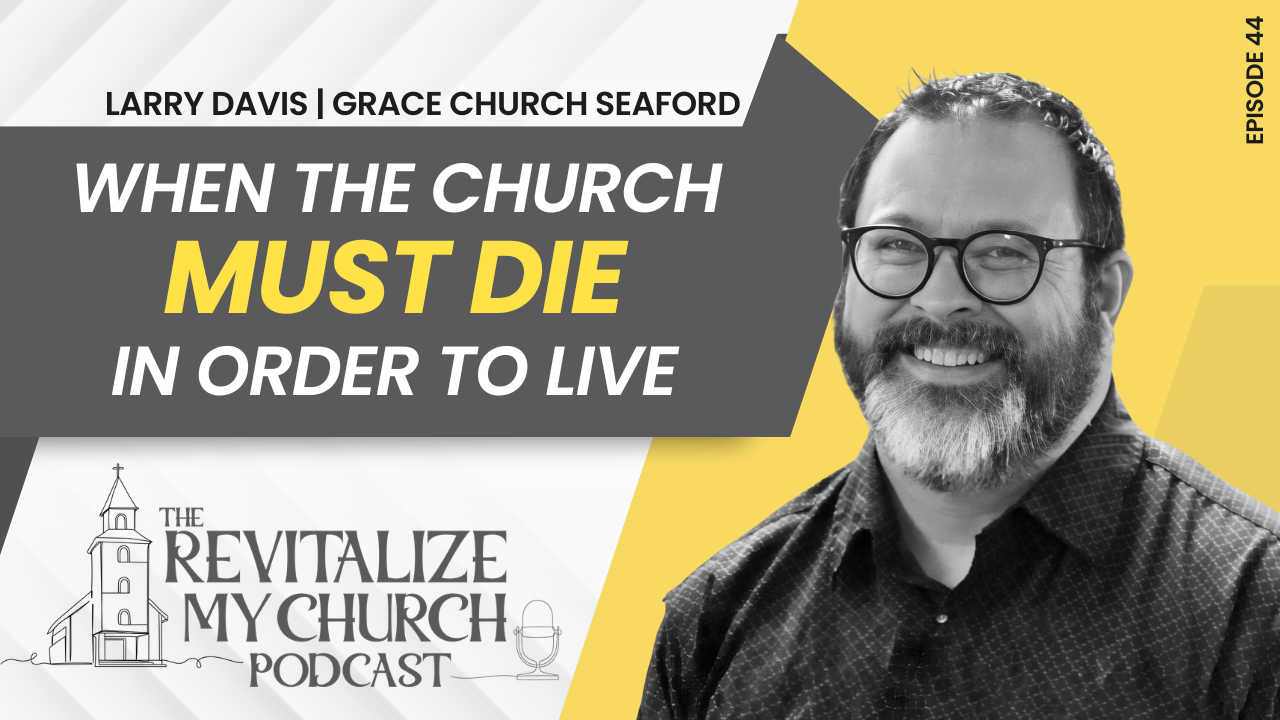
Ep. 044 | When the Church Must Die in Order to Live
Grieving the Loss of the Church You Love
Listen on Spotify | Listen on Apple Podcasts
Pastor Larry Davis on Grieving, Letting Go, and Leading Your Church to Resurrection
May 15, 2026
Episode 44: Show Notes
TLDR: Key Takeaways
1. Most churches assume every congregation should live. Larry Davis challenges that assumption head-on. Scripture itself shows us that local churches have a natural life cycle, and resisting that reality may do more harm than good.
2. A congregation cannot embrace something new until it grieves what was. This single principle, drawn from both Kubler-Ross and change management theory, is the foundation of the entire book and of Larry's approach to revitalization.
3. Trying to lead change before a church is ready will backfire. Implementing change while a congregation is still in the grief cycle produces visceral resistance, fractured relationships, and in many cases the removal of the pastor.
4. The core team must reach acceptance before the congregation is asked to change. The meeting before the meeting is not optional. Without it, even a good idea will be defeated in the open congregational gathering.
5. Resurrection looks different for every church. It might be growth, a merger, a replant, or even a graceful closure where the assets get reinvested in new kingdom work. Prayer, not a formula, is what guides the outcome.
Episode Summary
Is your church declining and you are not sure what to do about it? Are you implementing changes that are meeting fierce resistance? Are you wondering whether your church can actually be turned around, or whether it is already too late?
In this episode of Revitalize My Church, Bart Blair sits down with Pastor Larry Davis, author of Grieving the Loss of the Church You Love and Associational Missionary for the Eastern Baptist Association, to explore a perspective on church revitalization that most books miss entirely. Larry has personally led three church revitalizations, co-planted a church, and has now assisted or consulted with more than 110 churches navigating their own renewal journeys.
The conversation is honest, pastoral, and full of practical insight for any pastor trying to lead a struggling congregation toward new life.
Does a Local Church Have a Natural Life Cycle? What Larry Davis Found in Scripture
Most revitalization authors start with the assumption that every church should live, and work backwards from there. Larry Davis started with a different question, posed to him by friend and seminary professor Randy Millwood: Does the local church have a natural life cycle?
When Larry searched Scripture, he landed in Revelation chapters 2 and 3, where Jesus addresses seven churches in Asia Minor. Not one of those churches still gathers in that form today. Within one to two generations, every one of them was gone.
"If we have this in Scripture, why do we insist that every local expression of the church must live indefinitely?"
That question reframed everything. The death, burial, and resurrection cycle is not only how we come to Jesus personally. It is how he renews his church. Embracing that reality, rather than fighting it, is the first step toward genuine revitalization.
Why Trying to Save a Dying Church Before It Is Ready Can Make Things Worse
One of the most challenging ideas in Grieving the Loss of the Church You Love is that well-intentioned efforts to keep a dying church alive can actually cause more harm than good. Larry writes that the attempts to lead change in a church clinging to a false promise of life may delay an impending death, but generally result in a more excruciating and undignified end.
He has seen it firsthand. A pastor recognizes the decline, begins implementing change, and the congregation reacts viscerally. Pastors get removed. Long-term relationships get fractured. The church ends up worse off than it was before the intervention began.
The reason this happens is almost always the same: the change was introduced before the church was emotionally and spiritually ready to receive it.
Why a Congregation Must Grieve What Was Before It Can Embrace What God Is Doing Next
This is the spine of the entire book. Larry traces the principle to the overlap between change management theory and the Kubler-Ross grief framework. John Kotter, the foremost expert in organizational change management, developed his eight-step model by drawing directly from Kubler-Ross's work on the stages of grief.
The core insight is simple but profound: people cannot embrace something new until they have worked through the process of grieving what was. A congregation that is still clinging to hope based on little management tweaks, rather than genuine surrender, is not yet ready to receive a new vision. Trying to cast that vision too early will almost always fail.
The pastor's role in revitalization is not just to cast vision. It is to shepherd people through grief so they are ready to say yes to whatever God wants to do next.
How Do the Five Stages of Grief Apply to a Declining or Dying Church?
Larry walks through each stage and explains what it looks like in a local church context. The stages are not linear. A congregation can move through one and find itself back in it again. But recognizing where a church is in the cycle is essential for knowing how to lead it.
Denial: When a Church Refuses to Admit It Is in Decline
The church is not willing to acknowledge there is a problem. Everything is fine. This is simply how churches are. Decline is normal. Nothing needs to change. Denial often presents as contentment, but it is actually avoidance.
Bargaining: When a Church Tries to Fix Itself Without Actually Changing
The church begins looking for solutions that do not require radical change. Common bargains include hiring a younger pastor (believing a young family will attract young families), updating signage, or launching a new program. Larry shares a story about purchasing new letter sets for a church sign, knowing full well the letters would not grow the church. Sometimes you have to let a congregation work through a bargain so they can see for themselves that it will not work.
Anger: When Resistance to Change Turns Into Blame
Blame gets directed outward. At the pastor, at the new ideas, at the leadership team, at the community around the church. Larry heard it said directly that the surrounding neighborhood was simply not spiritual enough to support the church. Anger is often a defense mechanism against having to own the reality of decline.
Depression: The Difference Between Secondary and Preparatory Grief
The congregation begins to realize the decline is real and the church may actually die. Larry draws an important distinction here between two types of depression. Secondary depression is a reaction to what is happening, and it can be addressed. Preparatory depression is different. It is the kind of grief that actually prepares a person, or a congregation, to accept what is coming. Preparatory depression is not something to fix. It is something to walk through with patience and compassion.
Acceptance: When a Church Becomes Ready for Resurrection
The congregation reaches a place of readiness. They are no longer fighting the reality of where they are. They are open to whatever God wants to do next. This is the threshold of resurrection, and it is the place where genuine revitalization can begin.
How Larry Davis Handled Fierce Resistance at Grace Seaford Church
When Larry arrived at Grace Seaford Church in Seaford, Delaware, the congregation had dwindled to about 20 people and was considering closing its doors. Getting the church from that place to a thriving, growing congregation of 170 that has planted another church was not without conflict.
Larry describes Wednesday night suppers where longtime members would stand up in anger at proposed changes. His approach to those moments was strategic.
• He built a core team of key leaders who met with him every Sunday afternoon. These were the people who had reached acceptance first and understood the why behind every proposed change.
• When anger erupted in the open meeting, Larry did not stand up to defend the change himself. He had an 80-year-old deacon stand up and explain the reasoning. The congregation would not argue with the longtime saints of the church.
• He went to his detractors personally. He had coffee and lunch with the people who opposed the changes, practicing Matthew 18 before things ever escalated.
• He made sure that by the time any change reached the congregation, the leadership team was already unified. The meeting before the meeting was never optional.
What Is Cascading Communication and Why Does It Matter in Church Revitalization?
Bart and Larry found strong common ground in a communication model that Bart calls cascading communication. The idea is that change should move through a church in three rings, not be dropped straight into the congregational meeting.
• Ring 1: The inner circle. Primary decision makers, whether that is pastor and elders, pastor and deacons, or a church council. This group must be unified first.
• Ring 2: Key stakeholders. People who are not primary decision makers but carry significant relational influence in the congregation. These are the Susies in the room. If Susie hears about a change for the first time at the same moment as Sally, and Susie looks uncertain, the momentum collapses. Susie must be on board before the congregational gathering.
• Ring 3: The congregation. Only after rings 1 and 2 are aligned should the change be brought to the broader church.
Skipping ring 2 is one of the most common and costly mistakes in church revitalization.
What Does Church Resurrection Actually Look Like After the Grieving Process?
Larry is careful not to prescribe one outcome. Resurrection looks different for every church, and that is by design. The prayer process outlined in the book is meant to lead a congregation to a place of surrender and openness, not to a predetermined conclusion.
What resurrection has looked like for the churches Larry has walked through this process:
• A church that implemented healthy systems, began reaching families in the community, and saw explosive growth within the first six months (Grace Seaford)
• A church that merged with a nearby congregation, crossing denominational lines
• A church that went through a replant with new leadership and a fresh mission focus
• A church that reached a graceful end, held a celebration of its ministry, and watched its property and assets get reinvested directly into new church plants in the region
Larry's team actually held a funeral service for that last church, celebrating what God had done through it over the decades. The building was sold and the proceeds went into funding new kingdom work within an hour of where the church had stood.
"You cannot prescribe what God will do. You can only shepherd people to the place where they are ready to receive it."
How to Know If Your Church Is Healthy: A Simple EKG Framework for Pastors
Bart introduced a diagnostic tool in the conversation that resonated strongly with Larry. Think of it as an EKG for the local church. There are four primary indicators to watch.
• Are people getting saved? Evangelistic fruit is one of the clearest indicators of a church's spiritual health.
• Are people getting baptized? Baptism is both a spiritual milestone and a visible marker of outward growth.
• Is the church's prayer life focused outward or inward? A congregation that prays primarily about its own aches, needs, and internal concerns has turned inward. A healthy church prays for the community around it and for the lost by name.
• Where is the budget focused? A church whose finances are almost entirely directed at internal needs and maintenance is revealing something important about its spiritual posture.
If those four indicators are consistently pointing inward, the church is likely in decline. The earlier a pastor can read those signs and act, the more options are available.
Why Reaching Out for Help Early Is the Most Important Step for a Struggling Church
One of the most practical takeaways from the conversation: the earlier a church acknowledges it is trending in the wrong direction and reaches out for help, the better its chances of genuine renewal.
Just as a medical condition caught early is far more treatable than one that goes unaddressed for years, a church that seeks help before it reaches the critical stages of decline has far more options available. It has more relational goodwill, more financial flexibility, and more time to move through the grief process without the urgency of imminent closure bearing down on it.
The problem, as Larry and Bart both acknowledge, is that churches tend to become myopic. Leaders inside the decline often cannot see it clearly because they are too close to it. Getting an outside voice in early, whether a coach, a consultant, or a denominational leader, can make the difference between a church that finds new life and one that simply lingers in an unhealthy place until it dies.
"There is no quick fix. There is no silver bullet. But if you reach out early, there is real hope."
Resources Mentioned in This Episode
• Grieving the Loss of the Church You Love by Larry Davis, available on Amazon and Barnes & Noble
• You Wouldn't Believe Me If I Told You by Larry Davis (forthcoming), a collection of humorous ministry stories with proceeds supporting pastoral counseling. Submissions welcome at PastorLarryDavis.com
• Autopsy of a Deceased Church by Thom Rainer, referenced by both Bart and Larry as a foundational diagnostic resource for church decline
• Transforming the Rural Church in America by Shannon O'Dell, the book Larry was reading during the Christmas fast that prompted him to leave the megachurch and pursue revitalization
• Our Iceberg Is Melting by John Kotter, referenced for its eight-step change management model and its roots in Kubler-Ross's grief research
• On Death and Dying by Elizabeth Kubler-Ross, the foundational work behind the five stages of grief that Larry applies throughout his book
Connect with Pastor Larry Davis
Larry Davis is Senior Pastor of Grace Seaford Church in Seaford, Delaware, and Associational Missionary for the Eastern Baptist Association. He has personally led three church revitalizations and has assisted or consulted with more than 110 churches. He is available for speaking and consulting engagements.
• Website: PastorLarryDavis.com
• Speaking and consulting inquiries: pastor@graceseaford.org
• Eastern Baptist Association: easternbaptists.com
Questions for Reflection and Discussion
1. Where do you think your congregation is in the Kubler-Ross grief cycle right now? Denial? Bargaining? Anger? Something else?
2. Have you tried to introduce change in your church before the congregation was ready to receive it? What happened?
3. Who are the key stakeholders in your church, those who are not primary decision makers but who carry significant relational influence? Are they aligned with the direction you are trying to lead?
4. When you run the EKG on your church, what do the four indicators tell you? Are people being saved? Are people being baptized? Is prayer focused outward? Is the budget pointed at mission?
5. Is there someone outside your church, a coach, a consultant, a denominational leader, who could help you see your situation more clearly? What is keeping you from reaching out?
Share This Episode
If this conversation gave you language for what you are experiencing in your church, or challenged the way you think about revitalization, share it with:
• Your church leadership team, elders, or deacons
• A fellow pastor who is navigating a difficult season
• Your denominational or associational leader
• Church planter networks in your area
Subscribe and Stay Updated
New episodes of the Revitalize My Church Podcast release on the 1st and 15th of every month. Subscribe wherever you listen to podcasts or visit revitalizemy.church for archives, articles, and tools designed to help small church pastors lead well.