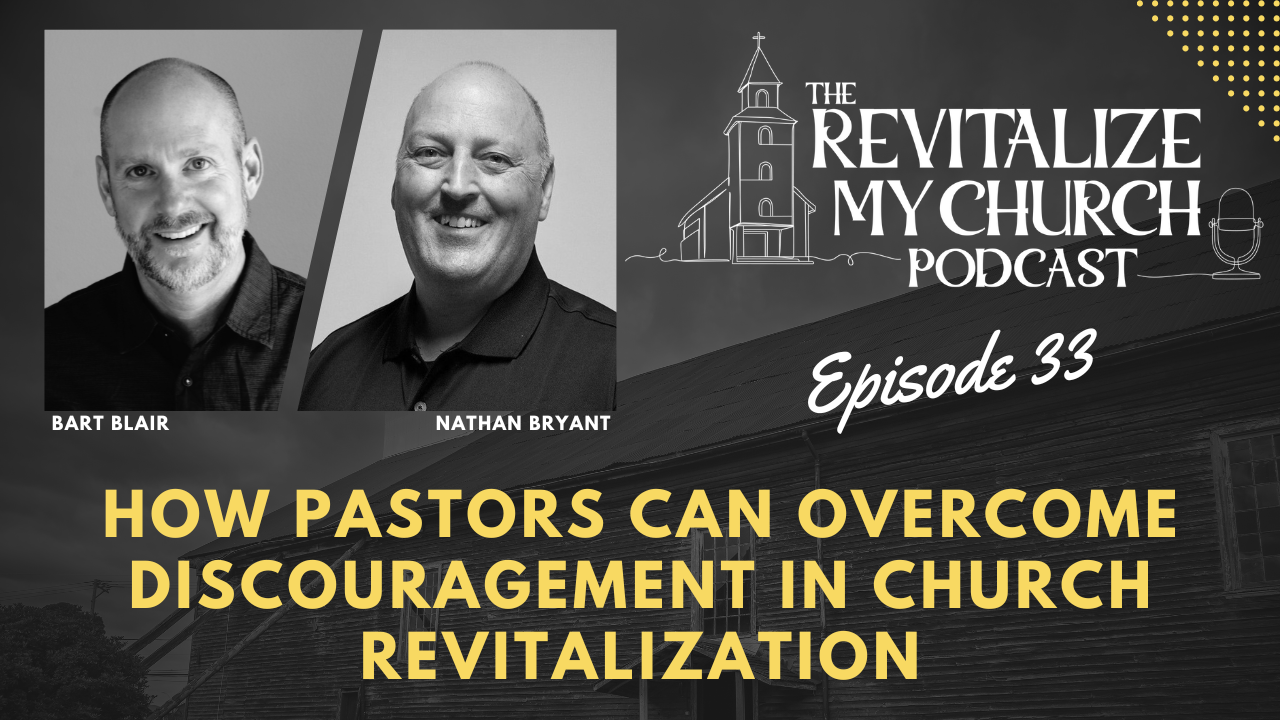
Ep. 033 | How Pastors Can Overcome Discouragement in Church Revitalization
Five Biblical Steps to Regain Your Fire for Ministry
Listen on Spotify | Listen on Apple Podcasts
Overcoming Discouragement in Local Church Ministry
December 1, 2025
Episode 35: Show Notes
Hosts: Bart Blair (Director of Church Revitalization, Assist Church Expansion) & Nathan Bryant (Executive Director, Assist)
Your identity in Christ matters more than your ministry metrics. God loves you for who you are, not what you accomplish, and this is the foundation for sustainable, joyful ministry.
Delegation isn't weakness—it's biblical leadership. Create a task inventory, identify what only you can do, and invite others to serve in their areas of gifting.
Rest is not optional. Block off one full day monthly for personal retreat to reconnect with Jesus, process your burdens, and restore your soul.
Episode Summary: Understanding Pastor Burnout in Church Revitalization
In this episode, Bart and Nathan discuss the reality of discouragement many pastors face during church revitalization efforts. They provide five biblical and practical steps to help pastors regain their momentum, refocus on their calling, and enter 2026 with renewed passion for ministry.
As the year comes to a close, many pastors find themselves exhausted, discouraged, and questioning whether their efforts have made any real difference. Whether you've experienced resistance to necessary changes, watched key members leave, failed to meet attendance goals, or simply felt the weight of carrying too much responsibility alone, this episode offers biblical wisdom and practical strategies to help you recover your sense of purpose.
Common Sources of Discouragement for Pastors in Church Revitalization
Why Pastors Struggle with Discouragement During Church Revitalization
Discouragement in ministry comes from many sources, and church revitalization can intensify these pressures. Nathan Bryant identifies several key sources:
Comparison with other successful churches and pastors — Social media and networking events constantly expose you to other churches' growth numbers and "wins"
Physical and mental fatigue — Your brain never truly shuts off from ministry concerns, even when your body is exhausted
Unmet goals and expectations — You set ambitious targets for baptisms, attendance, or budget but fall short
Loss of people — When church members leave, the relational pain cuts deeper than numeric loss
Persistent resistance to change — Even positive improvements face pushback from those attached to "how things have always been"
Nathan explains that one of the most discouraging aspects of ministry is when people leave. You build relationships and trust, believing these connections will last forever, only to have someone walk away. That relational loss shakes your confidence in your calling. Beyond lost relationships, the constant mental engagement with ministry concerns leads to exhaustion that compounds throughout the year.
The Real-World Challenge of Resistance in Church Revitalization
Bart shares a powerful example from his recent work with pastor Jerry in Anderson, South Carolina. Jerry led his church through what seemed like a simple project—repainting the inside of the building and refreshing the hallways and sanctuary with brighter, cleaner colors. Yet even this minimal change encountered resistance.
Why would people resist something as simple as a fresh coat of paint? Every person in your congregation has their own expectations, desires, and emotional attachments. Aunt Susie may have paid for the original paint in 1976. Uncle Bill painted it with his own hands. For some members, touching that paint isn't just about aesthetics—it's about erasing a memory and losing a connection to beloved family members who may have passed away. When you understand this, resistance becomes less about stubbornness and more about emotional attachment and identity.
Five Steps Pastors Can Take to Overcome Discouragement in Church Revitalization
Step 1: How Pastors Can Look to Jesus for Restoration in Church Revitalization
Understanding Your Identity as a Pastor Beyond Performance
The foundational step in overcoming discouragement is remembering who you are in Christ. Bart and Nathan emphasize that you are called to be a child of God and a disciple of Jesus first, and a pastor second. This ordering matters profoundly.
In our performance-driven culture, it's easy to believe that God loves you more when you accomplish big things and see impressive results. But that's not how God's love works. God loves you unconditionally, not because of what you accomplish but because of who you are. Nathan explains: "We have never done enough to earn His love, and we certainly can't do anything to disown it. And so we are loved by God. And we need to rest in that as a starting point for anything for our ministry."
This fundamental shift reframes your entire approach to ministry. You don't have to earn God's love through results. Your value to God isn't tied to baptism numbers or attendance growth.
How to Lean Into Your Calling in Church Revitalization
Beyond simply resting in God's love, there's another dimension to finding restoration: leaning into the specific calling God has given you. Bart shares a mentor moment from his early ministry when he was overwhelmed by his inadequacy. His mentor, Pastor Jeff Thornley, asked him: "Has God called you?" When Bart affirmed yes, his mentor responded, "Well, He's the one who's going to do it through you. Have confidence in what God's going to do, not in yourself."
This shift is transformative. Your confidence isn't in your own abilities or strategic thinking. Your confidence is in the One who called you. God doesn't call the equipped; He equips the called. When you lean into your calling, you access a supernatural confidence that sustains you through difficult seasons.
Step 2: How Pastors Can Look Back on What God Has Already Done in Church Revitalization
Why Celebration Matters for Pastors Fighting Discouragement
One of the interesting dynamics Bart identifies in himself and many pastors he works with is a tendency toward constant forward motion. As a "high D" personality, Bart wants to charge the hill, overcome the next obstacle, and accomplish the next goal. In pursuit of the next thing, he often forgets to stop and celebrate what has already been accomplished.
This is a widespread challenge among high-achieving leaders and a significant source of discouragement because you're constantly focused on what's missing rather than what's present. God, throughout Scripture, consistently told His people to remember and celebrate His works. When the Israelites crossed the Jordan River, God instructed them to stack up stones as monuments to His faithfulness. When David faced difficult times, he repeatedly reminded himself, "I will remember the deeds of the Lord."
Simple Wins Every Pastor Should Celebrate in Church Revitalization
Nathan affirms this practice from his own experience. Even with his naturally optimistic approach, he finds himself moving quickly past small victories to focus on larger goals. The result is that important wins get overlooked:
A marriage was restored
A person made a deeper commitment to Jesus
Someone was baptized
A life was genuinely changed through your ministry
One person coming to Christ is worth celebrating, regardless of whether you hit your attendance goal. If your church was on life support and now it's still alive, still meeting, still functioning as a community of faith—that itself might be the miracle worth celebrating.
Bart emphasizes that sometimes the miracle isn't growth at all. Sometimes the miracle is simply that your church is still open, still alive, and still gathering people together around the gospel. In a culture where churches are closing at an alarming rate, the fact that your church exists and continues to function is something worth acknowledging with gratitude to God.
Step 3: How Pastors Can Check the Eternal Scoreboard in Church Revitalization
Looking Beyond Numbers: The Unseen Work of God in Church Revitalization
One of the most liberating perspectives a pastor can embrace is understanding that God is doing far more in and through your church than you can ever measure or see. The Apostle Paul writes in Philippians that we should "fix our eyes not on what is seen, but on what is unseen. For what is seen is temporary, but what is unseen is eternal."
Most pastors are deeply aware of measurable metrics: attendance, baptisms, tithes, budgets. These are easy to track and report. But they're dangerously incomplete as measures of ministry effectiveness. What about the person who came to faith in a quiet parking lot conversation? What about the spiritual healing that happened in someone's marriage? What about the transformation in someone's character through a small group conversation?
Nathan explains that when one person comes to know Jesus, there is celebration in heaven. The angels of God rejoice. This eternal perspective should reshape how we think about our ministry. That one baptism may represent far more significant kingdom work than an entire year of steady church attendance without spiritual transformation.
How Pastors Can Shift Their Perspective in Church Revitalization
The challenge is learning to trust God's scoreboard rather than your own. You may never know the full extent of what God is doing through your ministry. Your job is faithfulness; the results belong to God. This doesn't mean you shouldn't set goals or track progress, but it means recognizing that what you can measure represents only a fraction of what God is actually accomplishing.
You can preach with confidence even if your attendance numbers are small. You can baptize that one person and genuinely rejoice, knowing that you're participating in something far more significant than any statistical increase in membership.
Step 4: How Pastors Can Share the Load to Prevent Burnout in Church Revitalization
Why Pastors Do Too Much in Church Revitalization Efforts
One of the most common patterns Bart observes is a pastor carrying far too much responsibility. The pastor is doing the preaching, preparing the bulletins, printing and folding them, setting up chairs, vacuuming the carpet, managing the sound system, visiting the sick, counseling, and handling administrative details. This isn't sustainable, and it's often self-imposed.
Why does this happen? Several common reasons:
Modeling past experiences — Many pastors replicate the model of the pastor they knew growing up
Unrealistic congregational expectations — The church assumes the pastor should handle all ministry tasks
Natural "doer" personality — Pastors often prefer to maintain control over outcomes
Lack of delegation training — Many were never taught how to lead through others
The result is a pastor who is exhausted, carrying a load that was never meant to be borne by one person, and losing the margin necessary to lead effectively. Leadership cannot happen in a crisis mode of constant activity.
Practical Steps for Pastors to Delegate in Church Revitalization
Bart provides a practical exercise for overwhelmed pastors:
Create a spreadsheet listing everything you do weekly and monthly
Add three columns:
Tasks only you can do (e.g., preaching)
Tasks someone else could handle (e.g., printing bulletins, vacuuming, setup)
Who might help with each task
Recognize the distinction: Leadership means you're responsible for outcomes, but that's not the same as you doing everything yourself
Delegate strategically: Start with 2-3 tasks that would genuinely free up your time
Nathan shares that his mother managed a large family with ten children by having them work in rotating teams. Everyone had a responsibility, and the family functioned better when the load was distributed. This wasn't just practical; it was developmental.
Finding Joy in Service: Connecting Others to Their Calling
One of the beautiful dynamics of delegation is that you often connect people to their actual calling. Bart observes that many church members are waiting to be asked to serve. Some people don't want to preach or teach a Sunday school class, but they would absolutely love to serve in practical, hands-on ways.
When you delegate, you're not burdening people; you're giving them the opportunity to:
Use their spiritual gifts
Experience joy in serving
Feel connected to the church's mission
Develop their faith and leadership
Moreover, someone may be more gifted at a particular task than you are. An administrator might be far better at managing logistics than you. When you delegate to these people, you allow them to flourish in their area of gifting. They experience joy, the church benefits, and you gain space to focus on what only you can do.
Step 5: How Pastors Can Rest and Care for Their Soul in Church Revitalization
Why Pastors Need a Sabbath Practice During Church Revitalization
Jesus modeled something that many pastors neglect: regular withdrawal from ministry activity to spend time in prayer and restoration with His Father. Jesus repeatedly pulled away from His disciples, left the crowds, and went to solitary places to pray and reconnect with God. If Jesus needed this rhythm, how much more do we?
The concept of Sabbath is ancient and biblical. God commanded His people to cease from work, to rest, and to remember. Yet most modern pastors understand the theory of Sabbath while failing to practice it. Life is too urgent. Too many people need help. Too many crises demand attention. But things rarely settle down on their own, and meanwhile your soul is growing increasingly depleted.
How Pastors Can Implement a Personal Retreat Day
Rather than waiting for a two-week vacation, Bart recommends that every pastor block off at least one full day monthly for personal retreat. Ideally weekly, but monthly is realistic for most busy pastors. This isn't optional.
Key principles:
Block it on your calendar with the same commitment you'd give to a funeral or important meeting
Protect it religiously — only genuine emergencies override it
Choose your location — a park, lake, retreat center, or quiet space at home
Turn off all communication — put your phone away
Do actual ministry work — no sermon preparation, no planning, no email
What a Pastor's Personal Retreat Day Might Look Like
Nathan shares his personal practice. He would take a day off at least once every two months and bring three things: his hymnal, a notebook, and his Bible. He would drive to a quiet location, put his phone away, and get away from all communication.
The unique element was the notebook. Rather than trying to achieve a perfectly peaceful retreat, he would simply write. As he sang hymns, read Scripture, and prayed, he would write down everything that came to his mind. All the burdens, worries, concerns, and ministry challenges crowding his mental space got written on the page. He describes filling five, six, seven pages with this mental and emotional downloading.
This practice served a crucial purpose. When your mind is full of clutter—the family upset, the budget shortfall, the criticism, the program that flopped, the person who left—it's almost impossible to genuinely pray or encounter God. But when you externalize all of that, when you get it out of your head and onto paper, something shifts. Your mental space clears. You can then pray over this list, offer it to God, and experience the release that comes from genuine surrender.
Nathan describes the result: "So refreshed and so like, okay, God has all of this stuff I can't manage anyway. And I just came away with a much greater sense of peace and calmness and like all the stuff that's been on me, I'm now giving to the Lord."
Creating Space for Genuine Encounter with God
The goal of a personal retreat day is not productivity or spiritual performance. You're not trying to write a brilliant sermon outline or solve a difficult ministry problem. You're creating space for genuine encounter with God and remembering who you are and whose you are.
This practice is not self-indulgent. It's not abandoning your congregation. It's actually one of the most important things you can do for your congregation because you return refreshed, refocused, and reconnected to your purpose.
The Sixth Essential Practice: How Pastors Can Build Accountability in Church Revitalization
Why Every Pastor Needs a Peer Mentor
As a closing thought, Nathan emphasizes something that may be even more important than the five main points: every pastor needs another pastor. Not a denominational supervisor or a board member. Another pastor who understands your burden, isn't connected to your church, and with whom you can be completely transparent about the struggles, doubts, and challenges of ministry.
Ministry can be an isolating profession. You carry burdens your congregation doesn't fully understand. You face pressures and criticisms you can't fully process with your leadership team without affecting their view of the church. You need someone who gets it, who's been there, and who can listen, understand, pray with you, and encourage you without complicated dynamics or church politics.
How to Find an Accountability Partner as a Pastor in Church Revitalization
If you're fortunate enough to have another pastor in your community, reach out. Your churches may be very different. One might be an established congregation needing revitalization while another is a church plant. Your approaches to ministry might differ. None of that matters. What matters is that you both understand the weight of pastoral calling.
If you can't find a local peer, consider meeting virtually. Many pastors now have accountability relationships through Zoom or FaceTime with pastors in other cities or states. The relationship matters more than proximity. What's essential is someone outside your church context with whom you can be authentic, pray, process challenges, and receive encouragement.
Real Example: The Power of Peer Accountability
Bart shares his experience while pastoring in Alberta. He had another pastor in town named Bob Church. Bob and Bart would get together for coffee regularly and download on each other about the challenges and struggles they were facing. Bob was an encouragement to Bart, and Bart was an encouragement to Bob. Even though their churches were quite different and their gifting was distinct, they shared the common experience of being called to lead congregations.
Bart reflects: "That relationship was golden. It made an enormous difference in my ability to sustain my ministry with joy and hope." That's what a peer pastor relationship offers—mutual encouragement, prayer, and the gift of being truly known and accepted by someone who understands your world.
Action Steps for Pastors to Overcome Discouragement in Church Revitalization
Before the Year Ends
Take time to implement these action steps as you wrap up 2025:
Review your year with honest assessment — What did God accomplish? What people came to faith? What relationships were restored? Write these down.
Create that task spreadsheet — List everything you do weekly and monthly. Identify which tasks only you can do and which could be delegated.
Identify 2-3 tasks to delegate — Start small with something that would genuinely free up your time.
Block off your first monthly retreat day — Put it on your calendar for January and commit to making it the same day each month.
Commit to finding a pastor peer — Reach out to someone before January first and start building that relationship.
As You Enter 2026
Once the new year begins, focus on implementation:
Schedule those monthly personal retreat days religiously
Begin the delegation process you identified
Reach out to that peer pastor or mentor regularly
Implement the practices that will make 2026 different from 2025
Focus on establishing rhythms of rest, celebration, delegation, and peer relationship
Don't try to do everything at once. Build these practices into your rhythms gradually but intentionally.
Key Takeaway for Pastors in Church Revitalization
"God loves you. That's it. It's not about what we do or didn't do. We have never done enough to earn His love, and we certainly can't do anything to disown it. And so we are loved by God. And we need to rest in that as a starting point for anything for our ministry." — Nathan Bryant
Final Thoughts: Entering 2026 with Momentum and Hope
Discouragement is real in ministry. The resistance is genuine. The unmet goals are painful. The fatigue is overwhelming. But none of these realities change the fundamental truth that God has called you, God loves you, and God is at work in and through your ministry in ways far beyond what you can see or measure.
As you prepare to enter 2026, commit to these practices. Look to Jesus for restoration. Look back with gratitude on what God has done. Look at the eternal scoreboard. Look around for help through delegation. Look after your own soul through regular rest and retreat. Build a peer relationship with another pastor who understands your journey.
The local church needs healthy, rested, encouraged pastors who are grounded in their calling and secure in God's love. That pastor is you.