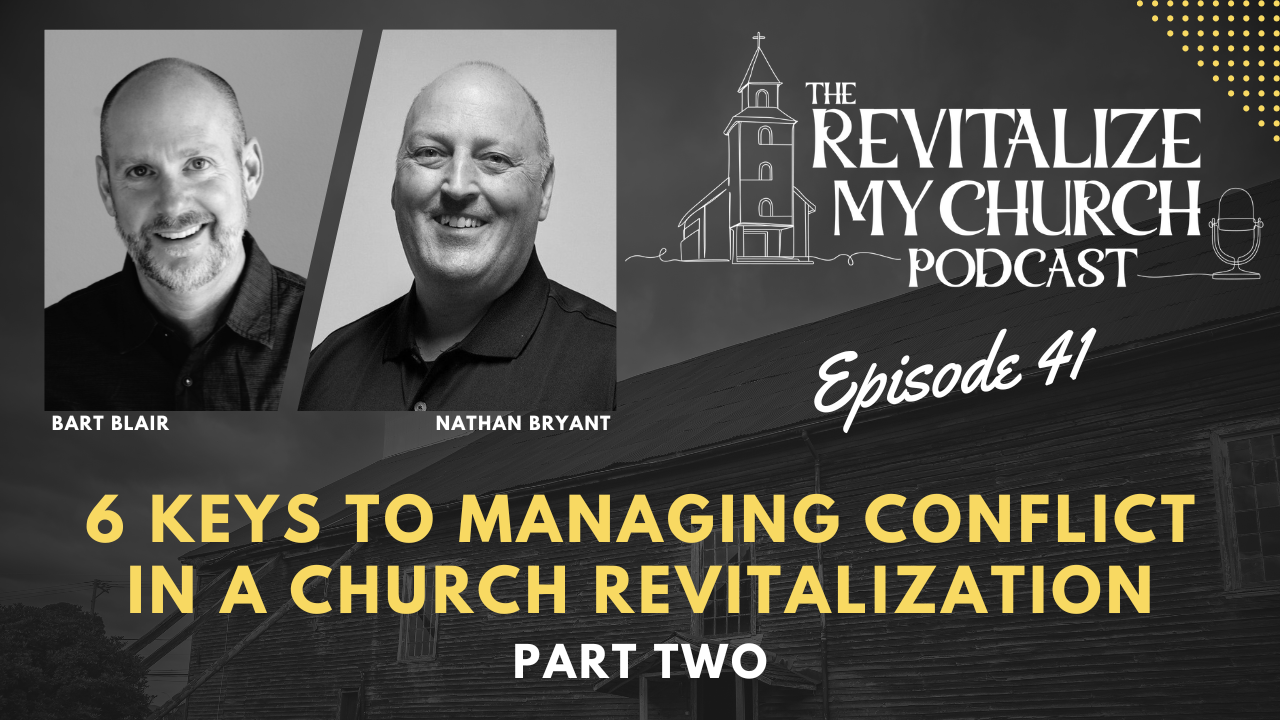
Ep. 041 | 6 Keys to Managing Conflict in a Church Revitalization - Part Two
How To Handle Conflict During Church Revitalization
Listen on Spotify | Listen on Apple Podcasts
Managing Conflict in Church Revitalization: 6 Essential Keys
April 1, 2026
Episode 41: Show Notes
Hosts: Bart Blair (Director of Church Revitalization, Assist Church Expansion) & Nathan Bryant (Executive Director, Assist)
TLDR: Key Takeaways
Check your own heart first - Before addressing conflict, examine your motivations, attitudes, and potential contributions to the problem (Matthew 7:3-5)
Deal openly, not publicly - Address conflict transparently with appropriate parties in proper settings, never air dirty laundry from the pulpit (Proverbs 27:5-6)
Seek win-win solutions - Aim for outcomes that strengthen relationships and unity, not just "winning" the argument (Philippians 2:3-4)
Bring in outside help early - Don't wait until conflict becomes unredeemable; involve trusted third-party mediators from your network
Not every conflict ends in win-win - Sometimes the healthiest resolution is helping someone find a better-fit church where they can thrive
94% of pastors report positive outcomes - When handled properly, conflict leads to better relationships, clarity, and stronger unity
Managing Conflict in Church Revitalization: 6 Essential Keys (Part 2)
TLDR: Key Takeaways
Check your own heart first - Before addressing conflict, examine your motivations, attitudes, and potential contributions to the problem (Matthew 7:3-5)
Deal openly, not publicly - Address conflict transparently with appropriate parties in proper settings, never air dirty laundry from the pulpit (Proverbs 27:5-6)
Seek win-win solutions - Aim for outcomes that strengthen relationships and unity, not just "winning" the argument (Philippians 2:3-4)
Bring in outside help early - Don't wait until conflict becomes unredeemable; involve trusted third-party mediators from your network
Not every conflict ends in win-win - Sometimes the healthiest resolution is helping someone find a better-fit church where they can thrive
94% of pastors report positive outcomes - When handled properly, conflict leads to better relationships, clarity, and stronger unity
How Do You Check Your Heart Before Addressing Church Conflict?
In part two of this essential series on managing conflict during church revitalization, Bart Blair and Nathan Bryant tackle the final three keys that every pastor needs to successfully navigate congregational disputes and maintain unity.
Why Do Leaders Need to Examine Themselves First?
Scripture Foundation: "Why do you look at the speck of sawdust in your brother's eye and pay no attention to the plank in your own eye?" - Matthew 7:3-5
Before entering any conflict situation, church leaders must:
Stop making assumptions - We often walk into conflict having already decided what the other person thinks, why they're upset, and what their motivations are - usually all negative assumptions
Check your attitude - Are you viewing this as a headache to manage or an opportunity to build better unity?
Believe the best - 1 Corinthians 13 reminds us that love "believes all things" - enter the room assuming the best about the other person
Examine your role - Have you communicated clearly? Made promises you didn't keep? Created unrealistic expectations? You may have contributed to the conflict without realizing it
What Does It Mean That Conflict Is Relational?
Even when conflict appears to be about decisions, programs, or practical matters, it almost always becomes relational. People take things personally - sometimes appropriately, sometimes not. As a leader, you need the humility to distinguish between:
Conflict actually directed at you personally
People reacting to situations, changes, or circumstances
Personality-driven responses you don't fully understand
Why Is It Hard for Congregation Members to Approach Their Pastor?
For most people (not all), approaching the pastor about a problem requires significant emotional and social courage. By the time they come to you, the issue has usually reached a significant level of distress for them personally.
This means they may have already:
Talked to others about the problem (gossip)
Let the issue fester and grow
Acted out or caused problems with other members
Built up significant emotional charge around the issue
Leaders need empathy for how difficult it is for average congregation members to voice concerns to their pastor. Stop being overly sensitive and recognize this as an opportunity for better connection.
What Did Jesus Say About Making Things Right?
In Matthew 5:23-24, Jesus gives a stunning command: If you're bringing a gift to the altar and you remember that someone has something against you (not that you have something against them), leave your gift and go make it right first.
This means:
God prioritizes reconciliation over worship
If someone has a problem with you, it's your responsibility to pursue them
Unity in the body matters more than religious activity
Humble leaders take initiative to resolve conflict, even when they're not sure they're at fault
Key #5: Deal Openly (Not Publicly)
Scripture Foundation: "Better is open rebuke than hidden love. Wounds from a friend can be trusted, but an enemy multiplies kisses." - Proverbs 27:5-6
What Does "Deal Openly" Actually Mean in Church Conflict?
Dealing openly with conflict means:
Not hiding or pretending problems don't exist
Addressing issues directly with appropriate parties
Creating frameworks where healthy disagreement is normal
Being transparent within proper boundaries
Choosing the right context for difficult conversations
What Does "Deal Openly" NOT Mean?
Many pastors confuse openness with public disclosure. Dealing openly does NOT mean:
Airing dirty laundry from the pulpit - This is actually disqualifying behavior for church leaders
Discussing private matters publicly - Protect people's dignity and privacy
Having serious conversations in front of others - If someone confronts you in the lobby with everyone watching, lovingly redirect: "I can see you're distressed. Let's step into an office" or "Let's schedule a time tonight or tomorrow to talk properly"
Broadcasting every detail to the entire congregation
How Do You Protect People While Being Open About Conflict?
Think about your marriage: You and your spouse don't have every conversation in front of your kids or in-laws. Some discussions happen privately between the two of you. The same principle applies in church:
Respect context - Different issues require different levels of disclosure
Protect dignity - Give people honor even when they're wrong
Choose appropriate venues - Board meetings, private offices, scheduled appointments
Maintain confidentiality - Don't gossip about people's struggles
Why Is Passive-Aggressive Behavior So Destructive in Churches?
Most people are passive-aggressive, which creates these toxic patterns:
The Surface Level:
Smiling and saying "everything's fine" while harboring resentment
Attending meetings but never voicing real concerns
Agreeing with decisions but complaining afterward
Pretending to be okay while talking to others about problems
The Underground Level:
Board members who wait until after decisions are made to express disagreement
People who never bring concerns to leaders but spread them through gossip networks
Congregation members who build entire narratives in their minds without ever seeking clarification
Leaders who remain oblivious to problems until they explode into major conflict
The Solution: As leaders, model openness and directness yourself. When you have concerns, address them promptly in appropriate settings. Teach your congregation the "go up, not out" principle - take issues to the person involved or to leadership, not to the gossip network.
What Is the "Go Up, Not Out" Principle?
This simple phrase (taught by Pastor Thornley) helps congregation members understand Matthew 18 conflict resolution:
"Go UP" = Take your concern directly to the person involved, or if that doesn't resolve it, to church leadership
"Go OUT" = Spreading the issue to friends, family, uninvolved parties, creating a gossip network
When churches adopt this principle, it prevents conflict from metastasizing throughout the congregation and creating unnecessary division.
Key #6: Seek Win-Win Solutions (When Possible)
Scripture Foundation: "Do nothing from selfish ambition or conceit, but in humility count others more significant than yourselves. Let each of you look not only to his own interests, but also to the interests of others." - Philippians 2:3-4
What Is the Right Goal When Resolving Church Conflict?
Your goal isn't just to "be done" with the conflict. The goal is to emerge with:
Better relationships moving forward
Improved communication and understanding
Stronger unity than before
Clarity on expectations and values
A sense that everyone was heard and respected
This means moving beyond "I'm right, you're wrong" thinking to "How can we both honor Jesus and move forward better together?"
How Do You Create Win-Win Solutions in Church Conflict?
Assume the best about people's intentions
What they want isn't necessarily bad or negative
Their concerns may be valid even if their approach is wrong
Look for the legitimate need or value underneath their complaint
Focus on the future, not just the past
Yes, address what happened
Yes, acknowledge hurt or mistakes
But emphasize: "How do we go forward better from here?"
Even when someone is clearly wrong:
Don't just extract an apology and move on
Help them understand the path to restoration
Work together on how to prevent it from happening again
Focus on rebuilding trust and relationship
Ask the right questions:
What are our shared goals underneath this disagreement?
What do we both truly value?
Are there creative alternatives we haven't considered?
How can we honor the concern while moving the mission forward?
When Is a Win-Win Solution Not Possible?
Reality check: Not every conflict can end in win-win. Sometimes the healthiest resolution is separation.
This happens when:
Someone demands something contrary to the church's mission, direction, or values
You're convicted the Lord is saying "go right" but they're insisting you must "go left"
The person refuses to compromise on non-essential matters
They're dug in and unwilling to consider alternatives
Fundamental philosophical differences can't be bridged
How Do You Handle Conflict That Leads to Someone Leaving the Church?
Real-world example: A church recently removed pews and installed chairs to create flexible space. One member wrote a two-page letter opposing the decision. The pastor's approach:
Listened with genuine care to understand the real concern (memorial pews ending up in a dumpster)
Found a creative solution (another church wanted the pews)
Maintained gracious, loving posture throughout
Avoided making it personal - kept focus on mission and values
Gave time for the person to process and ultimately come to acceptance
When someone truly can't stay: Even in the worst-case scenario, you can maintain dignity and love:
"I can see you love Jesus and want to see His kingdom flourish. You're seeing these things differently than we see them here, and that's unfortunate. It doesn't mean you're evil or I'm evil - we just have different convictions. That church down the street actually aligns with your philosophy on this. I want you to thrive in serving Jesus with your gifts. We'd love to have you here, but I don't want you to be frustrated. Maybe God has a better fit for you there."
This approach:
Affirms their faith and good intentions
Acknowledges the genuine disagreement
Removes personal animosity
Protects them from ongoing frustration
Helps them find a place to flourish
Maintains relationship (you'll see them at Walmart next week!)
What About Church Discipline for Unrepentant Sin?
In rare cases involving clear sin and unrepentance, church discipline becomes necessary. This requires:
Other elders involved from the beginning
Following a biblical process (Matthew 18)
Multiple attempts at restoration
Clear communication at each step
Exercising discipline only after exhausting other options
This is a separate conversation from typical conflict management, but it represents the most serious end of the conflict spectrum.
How Often Does Conflict Actually Lead to Positive Outcomes?
According to Christianity Today research, 94% of pastors report positive outcomes when conflict is handled properly, including:
Greater wisdom and maturity
Better-defined vision
Improved communication
Stronger relationships
Church purification
Growth in unity
The key is viewing conflict as an opportunity rather than a threat. 95% of the time (okay, 94%), conflict is leading you to a better place together because you're:
Clarifying what was unclear
Resolving what was unresolved
Addressing what was hidden
Strengthening what was weak
When Should You Bring in Outside Help for Church Conflict?
Critical principle: Bring in third-party help sooner rather than later. Don't wait until conflict becomes unredeemable.
Who Should You Call for Help?
First option - Your network:
District superintendents or overseers
Denominational leaders you trust and respect
Other pastors in your fellowship who can mediate
Church networks or associations you're part of
Second option - Professional mediators:
Organizations like Assist Church Expansion
Christian conflict resolution ministries
Trained church consultants
Why Is Early Intervention Critical?
If conflict goes on too long without resolution:
Positions become entrenched
Emotions escalate beyond reason
Narratives solidify in people's minds
Gossip networks spread misinformation
The situation becomes unredeemable
As a leader or elder, know your options BEFORE crisis:
Where can you appeal if you have conflict with the lead pastor?
Where can the lead pastor appeal if conflict arises with elders?
Who are the trusted third parties in your network?
What resources exist for mediation?
What Is the Pastor's Primary Responsibility in Conflict?
God has called church leaders to protect the unity of the body of Christ. There's nothing God wants more than His people dwelling together in unity.
This means:
Taking responsibility for maintaining unity (not assuming someone else will handle it)
Viewing conflict management as a core leadership function, not an interruption
Pursuing resolution actively rather than passively hoping it goes away
Loving people well through difficult conversations
Keeping the mission of God central while treating people with grace
Summary: The 6 Keys to Managing Conflict in Church Revitalization
From Part 1:
Face Reality - Conflict Will Come (James 1:2-4) - Normalize it, expect it, prepare for it
Move Toward It Quickly (But Wisely) (Ephesians 4:26-27) - The 48-72 hour rule; pray, process, act
Go Face-to-Face (Matthew 18:15-16) - Never use text/email; bring a witness when needed
From Part 2: 4. Check Your Own Heart First (Matthew 7:3-5) - Examine your motives, attitudes, and contributions before confronting 5. Deal Openly (Not Publicly) (Proverbs 27:5-6) - Be transparent with appropriate parties in proper settings 6. Seek Win-Win Solutions (Philippians 2:3-4) - Aim for better relationships and unity, not just "winning"
What Should You Do Right Now?
Immediate action steps:
Identify one conflict you're currently avoiding - schedule a meeting within 72 hours
Establish a covenant with your leadership team about how you'll handle conflict
Write down who you can call for outside help before you need them
Examine your heart: Are you viewing conflict as threat or opportunity?
Teach your congregation the "go up, not out" principle
Remember: Unresolved conflict creates more conflict. The unity of the body matters more to God than your comfort, your preferences, or even your worship. Leave your gift at the altar and go make it right.
Coming Next: Managing Resistance in Church Revitalization
In the next two episodes, we'll tackle a related but distinct topic: how to work through resistance when leading a church through change. While conflict and resistance overlap, they require different strategies and approaches.
Subscribe so you don't miss these critical episodes on navigating pushback during revitalization.
Resources for Managing Church Conflict
Download the Faith Communities Today (FACT) Congregational Conflict Study - insights from 14,000+ churches on conflict sources, costs, and outcomes.
About Revitalize My Church Podcast
Hosted by Bart Blair (Director of Church Revitalization at Assist Church Expansion) and Nathan Bryant (Executive Director), this podcast helps pastors and leaders of smaller, struggling churches navigate change and build healthy futures. New episodes release on the 1st and 15th of each month.
Subscribe so you don't miss Part 2 of this essential series on conflict management in church revitalization.
Is your church experiencing conflict right now? What questions do you have about implementing these principles? Share your thoughts in the comments below.
Connect With Us
Don't miss future episodes! Subscribe to the Revitalize My Church podcast wherever you listen (Apple Podcasts, Spotify, etc.) and leave a rating or review to help others discover the show.
About the Revitalize My Church Podcast: Since summer 2024, we've been helping church leaders navigate change and reorient to healthy futures. Our goal isn't to make small churches big—it's to help churches revision, revitalize, or restart find solid footing and healthy systems.