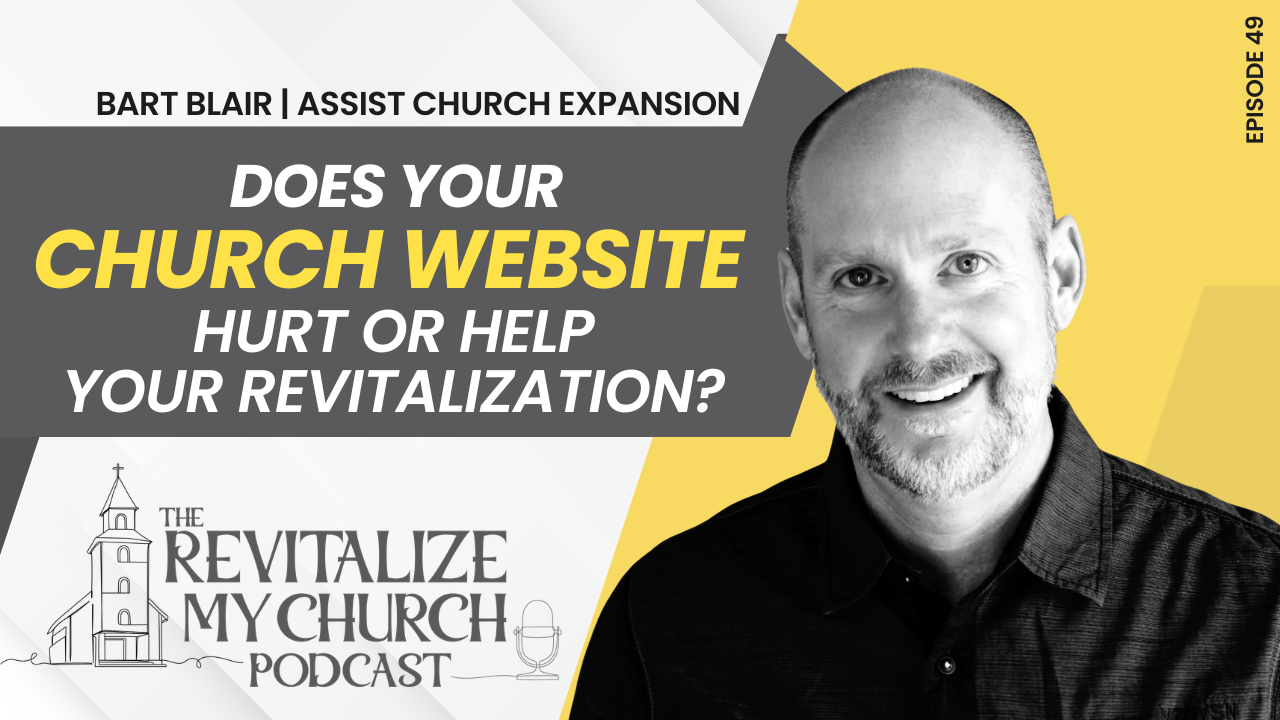
Ep. 049 | Does Your Church Website Hurt or Help Your Revitalization?
Four Things to Audit on Your Church Website
How AI is Changing the Way People Find a Church
August 1, 2026
Episode 49: Show Notes
About This Episode of the Revitalize My Church Podcast
Key Takeaways
Every website visitor who doesn't yet know Jesus is asking four unspoken questions: will I fit in, what do you have for my kids, who's in charge and can I trust them, and what's in it for me.
Your homepage needs authentic photos of real people in your church, not stock photography and not just pictures of the building or the stage.
Church websites are historically thin on content, and that hurts you with AI search tools like ChatGPT, Gemini, and Perplexity, which need written information to find and recommend you.
A simple fix is to have Claude AI evaluate your homepage and ministry pages, then help you add the content and structured data those tools need.
Reviews on Google, Yelp, and other directories now shape what AI tools say about your church, so claiming those listings and asking for reviews matters more than ever.
In this episode, Bart Blair walks through the four questions every unchurched visitor is silently asking when they land on your church website, then shifts to a growing challenge many churches haven't caught up to yet. People are increasingly finding churches through AI search tools instead of Google, and most church websites simply don't have enough content, or the right kind of content, for those tools to find and recommend them. Bart offers a practical, do it yourself exercise using Claude AI to evaluate and improve your site.
Will people feel like they fit in at your church
Bart opens with the question he believes matters most to an unchurched visitor: will I fit in here? He argues photos are the primary way a website answers this, and that homepages should be full of authentic images of church community life rather than stock photos or pictures of the building, the stage, or the worship team.
People will choose your church when they see the eyes of people whose lives have been changed by Christ.
Use real photos, not stock images. Even if your congregation skews older, showing your actual people is more trustworthy than stock photos of young families who aren't really there.
Recruit church members to take and appear in photos. Most phone cameras today are good enough for this job.
Show interaction, not just the service. Smiling, engaging, connecting, not rows of people with hands raised.
What does your church have for my kids?
The second question Bart identifies is what a visiting parent wants to know about children's ministry. He recommends plain, findable navigation and encourages churches without a full program to build one, even a small one, rather than leaving nothing prepared.
Name it plainly. Skip creative branding like "Rising Stars" in your nav bar in favor of clear terms like Kids Ministry or Children's Ministry.
Build a rotation if you don't have consistent attendance. Bart shares an example of a church that keeps a few volunteers on standby for the Sundays kids do show up.
Be honest about gaps. Use an FAQ section to acknowledge what you don't yet offer, such as middle school or high school ministry, while describing your plan.
Who is the pastor and can I trust them?
Third, Bart addresses the trust question, noting that many unchurched visitors carry wariness toward pastors given the frequency of negative church stories in the news. He recommends an easy to find staff and leadership page, with special attention to the senior pastor.
Include family photos and a personal bio, not seminary degrees or academic credentials.
Record a short faith story video from the pastor, and consider an informal interview with the pastor and spouse.
Prioritize relatability over credentials, since Bart argues the unchurched visitor doesn't care where you went to seminary.
What's in it for me if I visit this church?
The fourth question is the most countercultural, according to Bart: the visitor wants to know what's in it for them. He encourages churches to replace vision statements, slogans, and doctrinal language on the homepage with a clear benefit statement addressed to someone who doesn't yet know Jesus.
Avoid vague church language. Bart specifically warns against slogans like "reaching up, reaching in, reaching out" and phrases like "welcome home."
Speak to needs, not identity. Lead with statements about purpose, life's big questions, or curiosity about faith, rather than internal church vocabulary.
Revisit and test your benefit statement over time. A website isn't a fixed brochure, so churches can and should update this messaging as needed.
How are people finding churches through AI search?
Bart pivots to a broader trend: people are increasingly discovering churches through AI tools like ChatGPT, Gemini, and Perplexity rather than through a traditional Google search. He explains that these tools work conversationally and pull from a much wider set of sources than your website alone.
The A in AI does not stand for accurate. It's artificial intelligence, not accurate information.
AI tools search your full digital footprint, including Google reviews, Yelp, and directory sites, not just your website.
Online reviews shape AI generated answers about your church. Claiming directory listings and asking members for short reviews builds the sentiment these tools draw from.
Traditional SEO and AI search are not the same thing. Google returns a list of links for a person to sort through, while AI tools generate a direct, conversational answer.
Why doesn't my church show up correctly in AI search results?
Bart shares a personal example of researching his own church, Bear Creek Community Church, and discovering that some AI generated answers were pulling details from other churches with the same name because his own site lacked sufficient detail.
Most homepages are too thin on content. Bart notes the average homepage may need around 1,500 words to give AI tools enough to work with, while most church homepages run closer to 250 to 350 words.
Run a simple word check. Search your own homepage for how often words like church, family, or your city's name actually appear.
Common church names compound the problem. Churches with names like Grace, Cornerstone, or Hope face more risk of AI tools blending in information from unrelated churches.
How can I use Claude AI to improve my church website?
Bart closes with a practical, low cost exercise pastors can do themselves using Claude AI to evaluate and strengthen a website page.
Paste your homepage URL into Claude and ask for specific feedback on reaching people far from God and optimizing for AI search.
Ask Claude to help write additional page copy, especially for ministry pages like children's ministry, women's ministry, or small groups, aiming for roughly 1,200 to 1,500 words per page.
Ask Claude to write structured data or schema markup for your website platform, which helps AI tools and search engines understand your content.
Add FAQ sections to key pages, anticipating the specific questions people might ask an AI tool, then answering them directly.
For reflection
If a visitor with no church background looked at your homepage today, which of the four questions would your website actually answer, and which would it leave silent?
How much of your website's language is written for the 99 already inside your church, versus the 1 who isn't yet?
Share this episode with a pastor or ministry leader who could use a fresh look at their church's website and online presence.
Subscribe to Revitalize My Church wherever you listen, and visit revitalizemy.church for more resources on church health and revitalization.